
Reviewed · OSAKA CASTLE TOURS
Learning Zen of Japanese Calligraphy in kimono near Osaka Castle
Learning Japanese calligraphy in a kimono gives you two cultural activities in one compact session. You begin by dressing in traditional clothing, then sit on tatami mats to practice brush control, choose a kanji character, and create a finished work. I especially like the personalized kanji name tag and the fact that you receive digital photos of the experience.
The one-hour format is easy to fit around a visit to Osaka Castle, and children and first-time students are welcome. The main concern is practical: the venue has been difficult for some people to find, and there have been reports of cancellations during a temporary closure. Confirm the meeting details before setting out, and do not arrive more than 30 minutes late.
Key points to know before you book
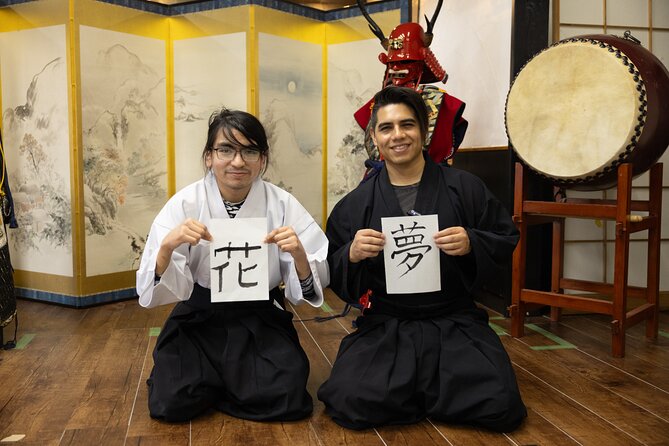
- Kimono first, calligraphy second: You change into traditional clothing before sitting down with the brush.
- Your name becomes a keepsake: The teacher writes your foreign name in selected kanji on a wooden tag.
- Beginner-friendly instruction: You practice posture, brush grip, stroke order, and the basic movements called tome, hane, and harai.
- Small group setting: The class accepts a maximum of 10 people, so the teacher can offer hands-on help.
- Photos are included: Staff take pictures in your kimono and send the digital files to your designated email address.
- Plan your arrival carefully: The location is a small storefront, and late arrival of more than 30 minutes can mean refused entry.
Kimono, tatami, and the first brush strokes
The class begins with a change of clothes, not with a lecture. You put on traditional Japanese attire such as a kimono or hakama, with staff helping you manage the layers and ties. One participant described the kimono as having about 12 parts, so allow a little patience at the start. It is part of the activity, not a quick costume change.
You should use the restroom before dressing. Hakama and other traditional clothing can feel warm, and the class involves sitting and practicing for a sustained period. The activity is not recommended for people with back problems or heart conditions, and it is not stroller accessible.
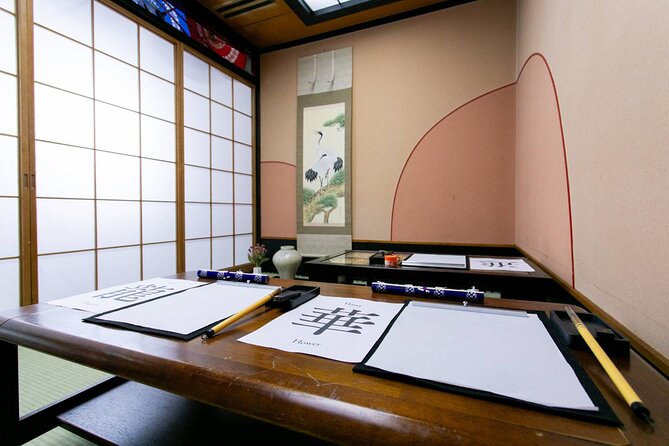
Once dressed, you move to the calligraphy lesson. The setting uses tatami mats, which helps the activity feel different from a standard craft workshop. You learn that shodo is more than decorative writing. Brush pressure, speed, posture, balance, and the order of each stroke all affect the final character.
I like this early explanation because it gives you a reason to care about the marks you make. You are not simply copying a Japanese symbol for a photograph. You are learning why the brush begins, pauses, lifts, and finishes in a particular way.
More ways to see Osaka Castle:
- Osaka Castle: Museum and Tower Entry Ticket
★ 4.5 · 2,380 reviews - Osaka Castle Walking Tour and Castle Tower Admission
★ 5.0 · 561 reviews - 5-Hour Osaka Bike Tour to the Neighborhood of Osaka Castle
★ 5.0 · 319 reviews
Learning shodo through three basic brush movements
The teacher introduces the main brush techniques, including tome, a controlled stop, hane, a lifting or flicking movement, and harai, a sweeping finish. These simple terms become useful once you start forming complete kanji.
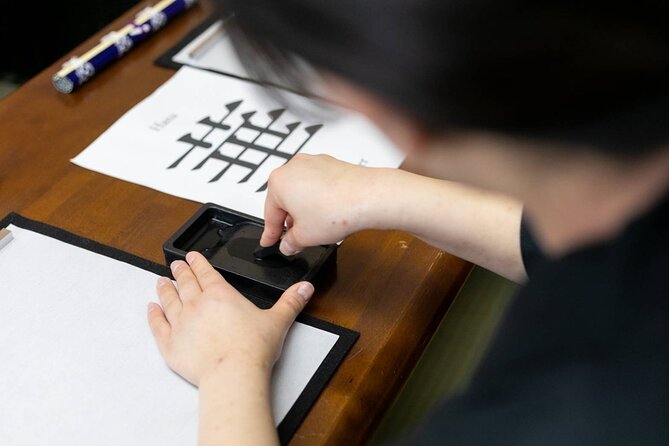
You first practice holding the brush and using the ink and paper. The teacher demonstrates the movement, then watches while you try it yourself. This is where the small maximum group size matters. A class of up to 10 is still a group activity, but it allows more personal attention than a large demonstration.
The instruction is designed for complete beginners. You do not need to read Japanese, and the English-speaking guide or translator helps explain the process. The default language is English. Italian, Spanish, French, Chinese, Thai, and Indonesian may be requested, but support depends on staff availability, so do not assume that a non-English guide will be present.
One limitation is that the historical and linguistic explanation may feel brief. The activity focuses on doing the work, and one participant wanted more background on the different Japanese writing systems. If you want a detailed lesson on hiragana, katakana, and kanji, this is not the right class. If you want to handle the brush and make something yourself, the balance works better.
Choosing a kanji with a personal meaning
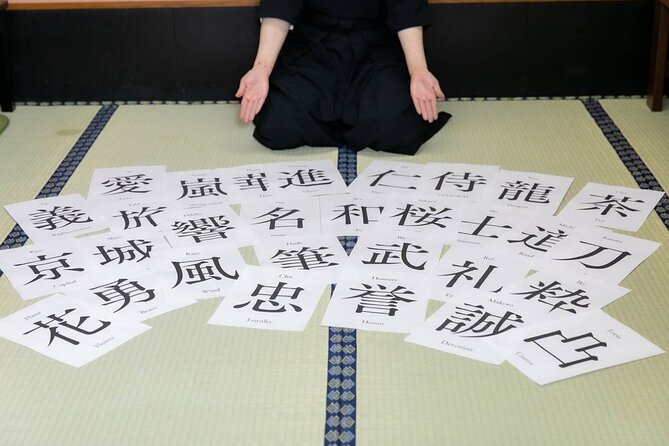
After learning the basic brush movements, you choose a kanji character to practice. Each character carries a meaning, and the choice gives the activity a personal angle. You might select a character connected with sincerity, loyalty, strength, peace, or another idea that matters to you, depending on the options presented in class.
The teacher then shows you the stroke order. This matters more than it may seem. Kanji are not drawings where you can simply copy the finished outline. The order and direction of the strokes help create the intended shape, rhythm, and balance.
You practice the chosen character several times before attempting the final draft. That practice sheet is useful because it removes pressure from the finished piece. Your first brush mark may be heavy, thin, crooked, or too wet. That is normal. The value of the lesson is seeing the difference between an uncertain first attempt and a more controlled final one.
Families can take part together, and the activity is open to all skill levels. Children may enjoy the novelty of the clothing and ink, while adults often appreciate the quiet concentration. Parents should remember that the class involves traditional materials and sitting on tatami, so younger children may need close supervision.
A wooden tag with your name in kanji
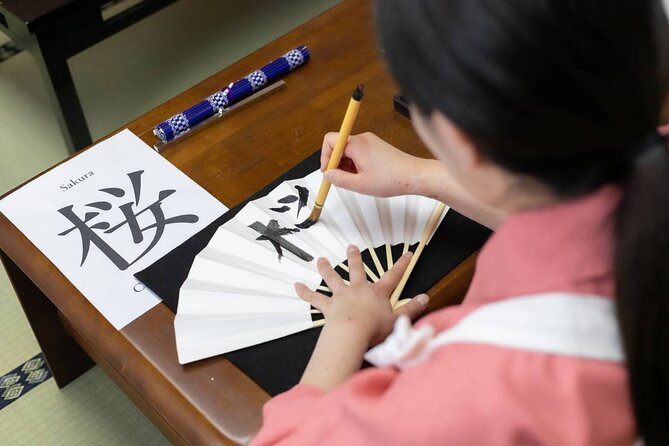
One of the most appealing personal touches comes after you select your character. The teacher writes each participant’s foreign name using kanji characters on a wooden tag.
This is not a direct translation in the same way you would translate a sentence. Kanji carry meaning and sound, so the result is a creative interpretation of your name. The teacher’s choice gives you a small souvenir that connects your identity with the writing system you have just practiced.
The name tag is also a good reason to listen during the explanation. Ask about the meaning of the characters used for your name. A character may suggest a quality or idea as well as approximate a sound. That makes the souvenir more interesting than a generic item bought in a shop.
You also receive a souvenir from the teacher, and your practice work may be gathered for you to take away. The exact final format can vary, with activity descriptions and participant accounts referring to finished work on items such as fans or scrolls. An additional decorative wall hanging may cost extra, so ask about any paid option before committing.
More kimono experiences in Osaka:
- Osaka: Sumo Show & Experience w/ Optional Kimono & Hot Pot
★ 4.5 · 609 reviews - Osaka: Kimono or Yukata Rental &Photos Service Options
★ 4.9 · 25 reviews - Kimono photoshoot-Includes 100 photo data
★ 5.0 · 21 reviews - Premium Kimono Dressing, Tea Ceremony, Calligraphy, Samurai show
★ 5.0 · 18 reviews
Creating the final piece and taking photographs
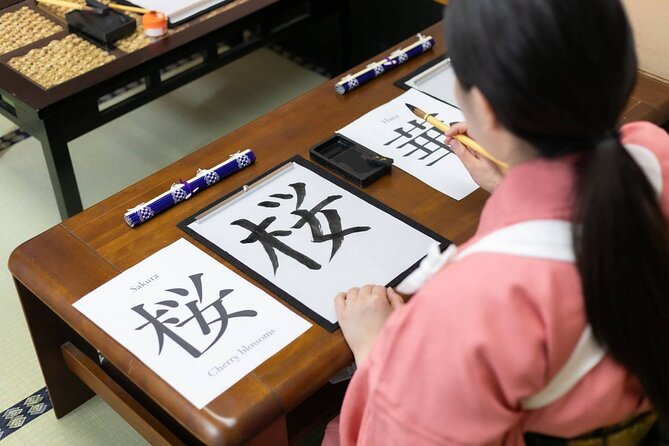
The final draft is your chance to apply everything from the lesson. You choose the character, follow the stroke order, and try to keep the brush movements steady. The teacher remains available to guide you, but the final mark is yours.
Do not expect professional calligraphy after one short class. The goal is a clear introduction to shodo and a meaningful piece of your own. The process rewards concentration more than speed. I would treat the final sheet as a personal record of the lesson rather than a polished work of art.
The photography portion follows. Staff take pictures of you in the kimono with your calligraphy. Digital photos are sent to the email address you provide, which is useful if you are traveling light and do not want to carry a printed souvenir.
Personal smartphone photography is allowed, but you may not take selfies or photograph other participants. Fixed tripods and video recording are not permitted because they can disturb the class. If photographs matter to you, rely on the staff photos and ask permission before taking your own.
Why this works well after Osaka Castle
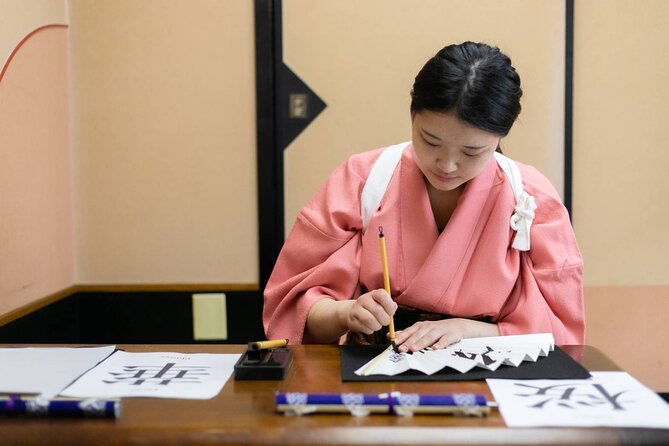
The activity is a natural companion to Osaka Castle. After walking through the castle area, you can spend an hour doing something quieter and more focused. The provider describes the venue as close to Osaka Castle Park Station, and one account places it about a minute from the station. That makes the timing convenient if you are building a half-day around the castle.
Do not rush from the park straight to the door. The address is in Joto Ward at 2-chome 3-19 Shiginonishi, listed as Excellence Takayama. The storefront can be easy to miss, even when map directions are correct. Give yourself extra time to identify the entrance and find the exact meeting point.
The end point is the same as the start point. There is no hotel pickup, station transfer, or private transportation. You arrange your own way there and back, which is simple if you are already near Osaka Castle but less convenient if your day is based in another part of Osaka.
Price, group size, and overall value
At about $43.59 per person, the price is reasonable for a short cultural class that combines clothing, instruction, photography, and a personalized keepsake. You are paying for more than an hour of brush practice. The price also covers the kimono or other traditional attire, the teacher, the translator support, digital photographs, taxes, and gratuities.
The value is strongest if you want an activity rather than a souvenir. You learn a few real shodo techniques, practice stroke order, and leave with a piece connected to your own name. The value is weaker if you are looking for an advanced calligraphy course or a long historical presentation.
The maximum group size is 10. That is small enough to feel personal, but it does not guarantee a private lesson. If you want one-to-one teaching, confirm the group size for your date before booking.
The activity is often booked well ahead, with an average booking time of about 36 days. That suggests planning ahead is sensible, especially if you have only a few days in Osaka. Free cancellation is available until 24 hours before the start time. Changes or cancellations inside that window are not refunded.
Important arrival and comfort advice
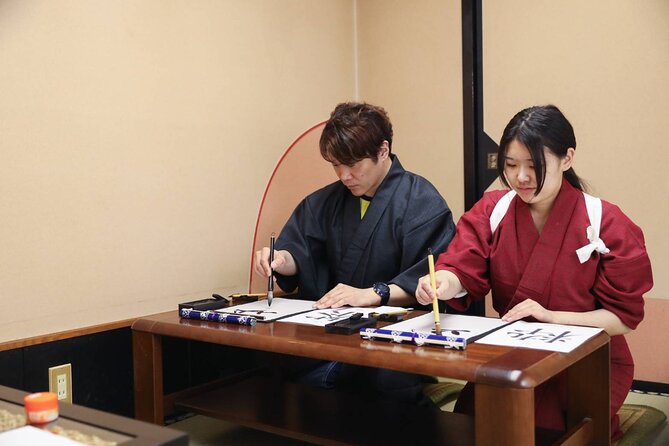
The strictest rule is punctuality. If you arrive more than 30 minutes late, even after contacting the operator, entry may be refused. This matters because dressing takes time and the class follows a set sequence.
The operator has also had a temporary closure that caused serious communication and arrival problems for some people. The stated closure period was June 9 through June 29, 2025, followed by a change in operator and management. That issue may have been resolved, but I would still confirm the date, address, and meeting instructions shortly before leaving your hotel.
The activity allows service animals, but it is not suitable for pets. It is also not stroller accessible. People with mobility or back concerns should think carefully about sitting on tatami and wearing fitted traditional clothing for the duration.
Hair styling with gathered hair and a kanzashi ornament is available for an added ¥3,300 per person. It is not included in the standard price, so decide in advance if you want the full styling effect for photographs.
Who will enjoy this calligraphy class most
I would recommend this for first-time visitors who want a hands-on introduction to Japanese culture. It suits couples, families, and friends who want photographs as well as a meaningful souvenir. It also works well for anyone who has already visited Osaka Castle and wants a calm change of pace.
The class is particularly good for you if:
- You want to wear a kimono without committing to a full-day rental.
- You enjoy crafts, drawing, or learning through practice.
- You want your name represented in kanji.
- You are traveling with children who can sit and follow basic instructions.
- You prefer a small-group activity with help in English.
I would choose something else if you need wheelchair or stroller access, dislike sitting on tatami, or want a serious study of Japanese writing systems. You should also skip it if you are uncomfortable with the health limitations listed by the operator.
Should you book it?
Book this class if you want a compact, friendly introduction to shodo with the added fun of kimono photos. The name tag, guided practice, and final piece give the hour more substance than a simple dress-up photo stop.
Before paying, confirm that the activity is operating on your date and copy the meeting address into your phone. Plan to arrive early, use the restroom first, and allow time to spot the small storefront. With those precautions, this is a good-value cultural activity near Osaka Castle, especially for first-time calligraphy students and families.
FAQ
How long does the calligraphy and kimono activity last?
The listed duration is approximately one hour.
Where does the activity begin and end?
It begins and ends at Japan, 536-0014 Osaka, Joto Ward, Shiginonishi, 2-chome 3-19, Excellence Takayama.
Is the activity close to Osaka Castle?
Yes. The provider describes it as near Osaka Castle, and the meeting point is also described as close to Osaka Castle Park Station.
Do I need previous calligraphy experience?
No. The class accepts all skill levels, including beginners and children.
What language is used during the class?
English is the default language. An English-Japanese or Chinese-Japanese translator helps with communication, and other languages may be requested subject to staff availability.
Is a kimono included in the price?
Yes. Traditional Japanese attire such as a kimono or hakama is included.
Are photographs included?
Yes. Staff take photographs and send the digital data to the designated email address.
Is hair styling included?
No. Gathered hair and a kanzashi ornament, called Wagami, are an optional extra costing ¥3,300 per person.
What happens if I need to cancel?
You can cancel up to 24 hours before the start time for a full refund. Cancellations or changes made less than 24 hours before the activity are not refunded.
More Zen and Meditation Sessions in Osaka
- Learn Zen in a class of making Matcha tea near Osaka Castle
★ 4.8 · 17 reviews - Osaka: Japanese Zen Massage and Facial at the Temple/180-min
★ 4.8 · 10 reviews - Osaka Temple: 1-Hour Evening Zen Chill Experience
★ 4.9 · 10 reviews - Osaka:Zen Tea Ceremony and Foot Bath Experience<45min>
★ 5.0 · 7 reviews
More Calligraphy Classes in Osaka
- Osaka: Private Japanese Calligraphy Experience
★ 5.0 · 66 reviews - Calligraphy Workshop in Namba, Dotonbori
★ 5.0 · 57 reviews - Osaka: Private Tea Ceremony and Calligraphy Experience
★ 5.0 · 50 reviews - Samurai dress-up and shows, plus Tea Ceremony & Calligraphy
★ 5.0 · 27 reviews
Just added in Osaka
- Urban Canvas: Osaka Street Art Bike Tour★ 5.0 · 10 reviews
- Anime Cosplay Photshoot-50 Digital Photos Provided★ 5.0 · 8 reviews
- TeamLab Botanical Garden Osaka Ticket★ 3.5 · 6 reviews
- Umeda Sky Building & Kuchu Teien Observatory Ticket in Osaka★ 4.5 · 3 reviews
- Immerse in Judo Martial Arts Class from Japan★ 5.0 · 4 reviews
- Cherry Blossom Buddha and Mt.Yoshino with Strawberry Picking Tour★ 4.5 · 5 reviews
- Discover Osaka’s Iconic Umeda Sky Observation★ 5.0 · 6 reviews
- Traditional Home cooking Experience in Osaka, Japan★ 5.0 · 14 reviews
Osaka Castle Tours, compared.
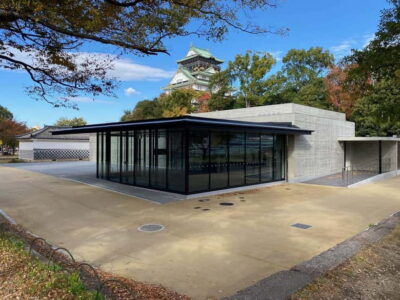

Osaka Castle Walking Tour and Castle Tower Admission
Read our review →
5-Hour Osaka Bike Tour to the Neighborhood of Osaka Castle
Read our review →
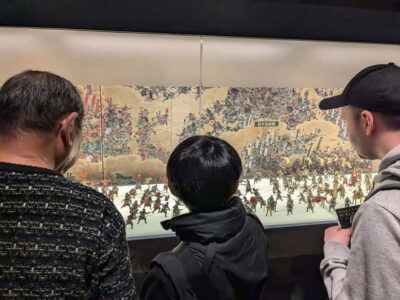

PRIVATE 6hr, Food tour from Osaka Castle, Kuromon, Dotonbori.
Read our review →
A Tour to Explore the Symbol of Osaka: Osaka Castle
Read our review →
Browse the lists this tour appears in