
Reviewed · WORKSHOPS
Osaka: Noh Performance with English Subtitles and Workshop
Noh can look mysterious at first: slow movement, masked faces, spare music, and a story that may not be obvious to modern eyes. This two-hour visit at Yamamoto Noh Theater solves that problem with an explanation before the show and English subtitles during it.
I like the clear welcome for first-time viewers, and I like the chance to handle masks, costumes, and musical instruments after the performance. The theater’s 1927 building, in Osaka’s former samurai residence area, also gives the evening a strong sense of place.
The main drawback is the art form itself. Noh is quiet, measured, and formal, not a fast-moving stage show. The performance lasts about an hour, so you need patience and an interest in traditional theater to get the most from it.
Key points at a glance
- A rare Osaka theater visit: Yamamoto Noh Theater opened in 1927 and is Osaka’s oldest Noh theater.
- English help throughout the show: A pre-performance explanation and English subtitles make the action easier to follow.
- The workshop comes after the curtain: Try Noh masks, costumes, and instruments once the performance ends.
- Easy to pair with Osaka Castle: The theater is about a 10-minute walk from the castle.
- A compact two-hour cultural stop: The format works well for an afternoon or evening in Osaka.
- Good value for curious beginners: At $32 per person, you get a performance, interpretation, and hands-on access to the art.
Why this Noh performance works for first-time viewers
Noh is one of Japan’s oldest forms of theater, but you do not need prior knowledge to attend this program. The visit begins with an explanation designed to give you a basic map of what you are about to see.
That introduction matters. Noh uses controlled movement, stylized gestures, masks, music, and language that can be difficult to follow without help. The opening talk gives you a better chance to notice what is happening rather than simply waiting for the performance to end.
English subtitles are provided during the show. If you do not speak Japanese, this is the feature that changes the experience from a cultural display into a story you can follow. The subtitles let you keep track of the meaning while watching the actors’ movements and listening to the music.
The program is not built around a long lecture. You get practical context, then the performance itself, followed by the workshop. That balance keeps the visit focused and makes the two-hour length manageable.
A few more Osaka half-days worth pricing up
- Sushi Making Osaka Roll and Authentic Japanese Sushi Class
★ 5.0 · 1,220 reviews - Matcha Making Class in Osaka with Authentic Japanese Sweets Set
★ 5.0 · 509 reviews - Osaka: Ramen and Gyoza Cooking Class in Dotonbori
★ 5.0 · 378 reviews
Inside Yamamoto Noh Theater near Osaka Castle
The theater is in a former samurai residence area, about a 10-minute walk from Osaka Castle. That location gives you an easy way to add traditional theater to a castle visit without crossing the city.
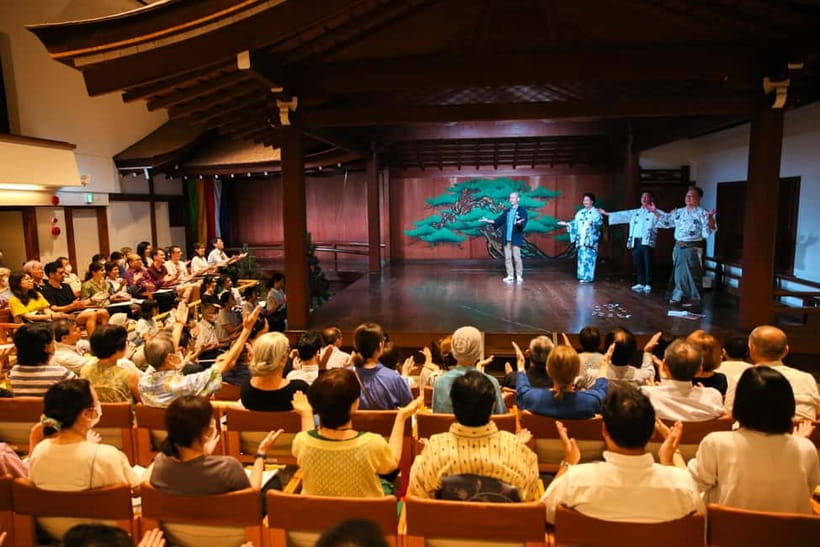
Yamamoto Noh Theater was established in 1927 and is the oldest Noh theater in Osaka. It was registered as a Japanese Tangible Heritage in 2006. Those details are useful because the building is not just a neutral event hall. You are attending a performance in a place with its own connection to Osaka’s traditional culture.
I would plan to arrive in the area with enough time to walk from Osaka Castle without rushing. The activity lasts two hours, but the surrounding visit can take longer if you combine it with the castle grounds. The theater’s location is especially useful for an itinerary that already includes Osaka Castle, rather than as a stop far from the rest of your day.
The information provided does not give a detailed seating plan or group size, so I would not book this expecting a private performance. Think of it as a scheduled theater visit with a shared audience and a structured workshop afterward.
The opening explanation: your guide to Noh
Before the performance, you receive an explanation of Noh. English and Japanese are the listed languages, and the program is arranged for people who may be seeing Noh for the first time.
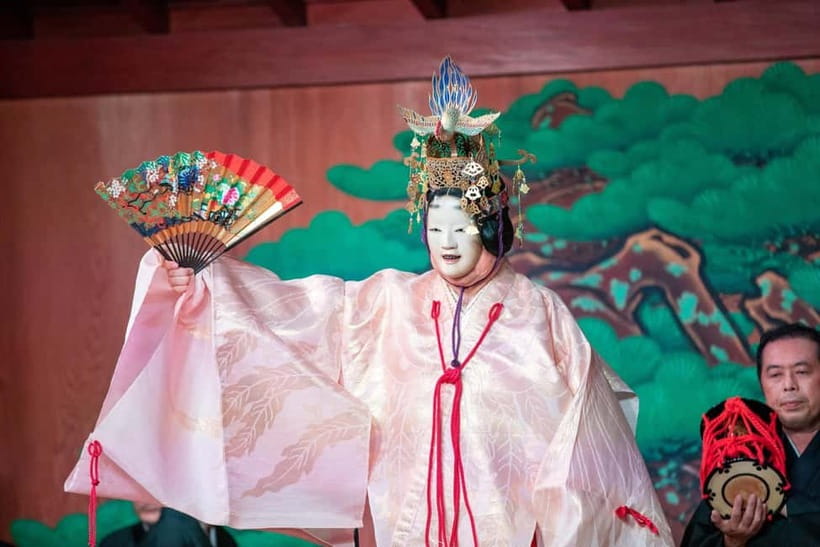
The best use of this introduction is to listen for the basic signals of the art form. Noh does not rely on naturalistic acting in the way a modern drama does. Movement is formal and economical. A mask can suggest a character’s emotional state, while a small turn of the head can change how light reaches the mask and alter its expression.
You may also hear about the musical side of the performance. Noh uses instruments and chanting as part of the drama, not merely as background music. The later workshop helps connect that explanation to objects you can see and handle.
One useful point from the program is that a translator can communicate with English-speaking audience members. After the performance, the theater’s owner answered more than 10 audience questions with the help of a translator. That makes the question period feel like a real chance to ask about the form, rather than a quick goodbye at the door.
Specific performer or guide names are not provided, so you should book this for the quality and structure of the program rather than for a particular presenter.
The one-hour performance and English subtitles
The performance lasts about one hour. For a first encounter with Noh, that is long enough to give you a real sense of the form without turning the visit into an all-day commitment.
You will see masks, costumes, stylized acting, and traditional music working together. English subtitles allow you to follow the story while watching the stage. That combination is important because staring only at subtitles can cause you to miss the small gestures that make Noh different from ordinary theater.
I recommend treating the show as a performance to observe, not a spectacle to photograph. Photography and video recording are not allowed inside. That rule protects the atmosphere and keeps phones from distracting the audience, but it also means you should not plan to document the masks or stage during the show.
Noh can feel slow if you expect a lively musical or a dramatic stage production with quick scene changes. Its power comes from restraint. Pauses, repetition, posture, and vocal tone carry weight. You will probably enjoy it more if you let the pace slow you down instead of waiting for constant action.
The subtitles are a major help, but they do not turn Noh into ordinary English-language theater. You still need to watch the actors and listen to the music. The result is best understood as a guided introduction to an art form, not a full explanation of every detail of Noh.
Same city, a completely different kind of afternoon:
- Osaka Go Karting Tour with Funny Costume
★ 5.0 · 2,658 reviews - Osaka Castle: Museum and Tower Entry Ticket
★ 4.5 · 2,380 reviews - Osaka: Shinsekai Food Tour with 13-15 Dishes at 5 Eateries
★ 4.8 · 2,204 reviews - Osaka Food Tour: 13 Dishes at 5 Local Eateries
★ 5.0 · 2,149 reviews
The hands-on workshop with masks, costumes, and instruments
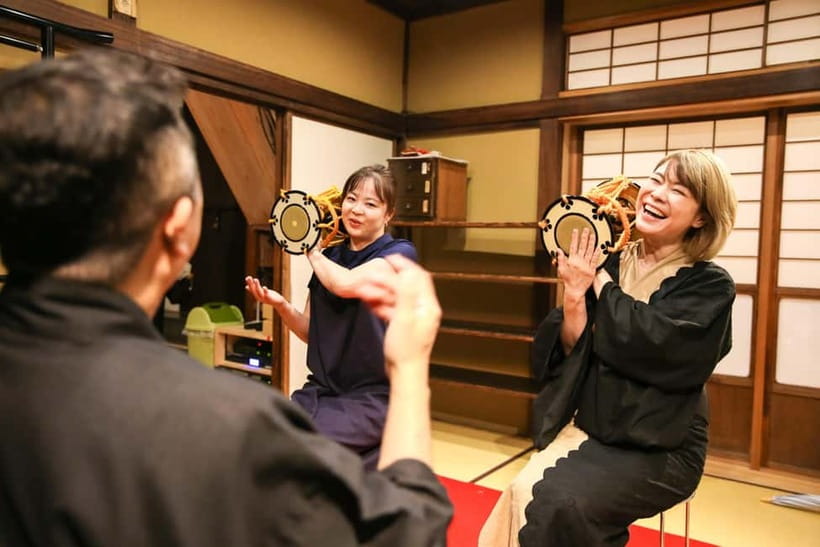
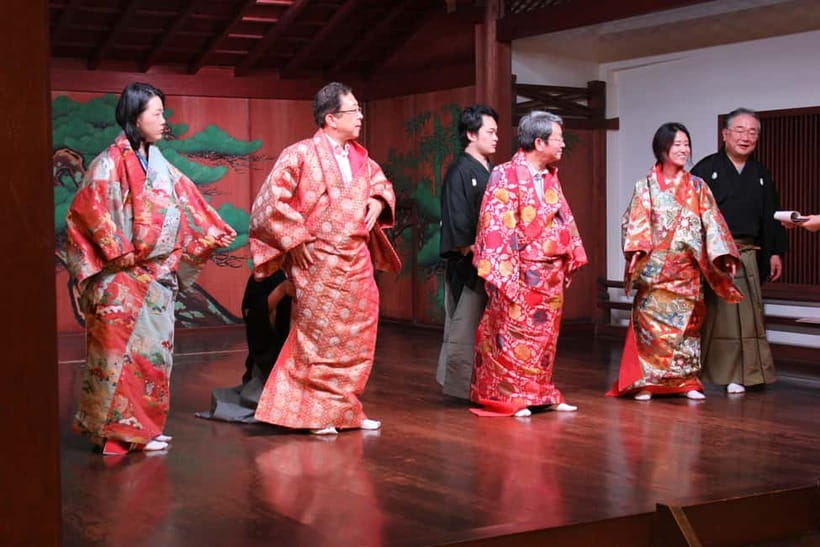
After the performance, the visit shifts from watching to handling. You can try on Noh masks and costumes, and explore the musical instruments used in the performance.
This is the part that gives the program a practical edge. A museum display can show you a mask behind glass. Here, you get a closer look at the objects and a chance to understand how they function as part of a performance.
Trying on a mask also changes how you think about Noh acting. A mask does not show a wide range of facial expressions like a bare face. The performer must use posture, head position, and controlled motion to suggest feeling. Even a short hands-on session can make the stage performance easier to appreciate.
The supplied details are clearest about trying the masks and costumes and exploring the instruments. One person specifically wished there had been more time with the instruments beyond the drum, as well as access to the musical text. That is a useful expectation to set: the workshop gives you contact with the tools of Noh, but it may not be an extended music lesson covering every instrument in detail.
If you are especially interested in Japanese instruments, ask questions during the session. English communication is available, and the post-show question period can help fill in gaps.
What the $32 price gets you
At $32 per person, this is a reasonable price for a specialized cultural experience in central Osaka. You are paying for a live performance, an introduction, English subtitles, and a hands-on session in a historic theater.
The value is strongest if you would not otherwise know how to approach Noh. Buying a ticket to a traditional performance without context can leave a first-time viewer puzzled. Here, the explanation and subtitles do real work, while the workshop gives you something to do after the show.
The price is less compelling if you want a long workshop or a full tour of Noh theater. The visit lasts two hours, and the performance takes about one hour, leaving limited time for the explanation and hands-on activities. It is an introduction, not professional training.
Still, the format makes sense for most Osaka itineraries. You get a focused cultural stop, then remain close to Osaka Castle and the city’s other central sights. The reserve-now, pay-later option also gives you flexibility while planning, and cancellation is free up to 24 hours in advance for a full refund.
Who should book this experience
I would recommend it to adults and older children who are curious about Japanese theater and want more than a standard sightseeing stop. It suits you especially well if you like guided cultural experiences but prefer a compact program rather than a full-day class.
It is also a good choice if you have already visited Osaka Castle and want to add something less familiar nearby. The theater’s history and setting make the visit feel connected to Osaka, rather than like a portable show that could take place anywhere.
The program is suitable for English-speaking visitors because of the subtitles, bilingual hosting, and translator support. If you speak neither Japanese nor English, the available information does not promise subtitles in other languages.
Children under seven are not permitted. Older children may enjoy the mask and costume session, but the slow pace of the performance may test younger attention spans. I would choose this for a child who already likes stories, theater, music, or hands-on cultural activities.
You should think twice if you want action, casual photography, or a performance you can understand without concentrating. Noh asks you to watch carefully and accept a slower rhythm.
Practical timing and access
The experience lasts two hours, with starting times depending on availability. Since the theater is about a 10-minute walk from Osaka Castle, I would allow extra time if you are coming from the castle grounds, especially if you are trying to arrive for a fixed performance time.
The theater is wheelchair accessible. The available information does not specify the exact route from nearby transport stops or details about seating, so contact the provider if you need particular access arrangements beyond general wheelchair access.
Photography and video recording are not allowed inside. Take your photographs around the surrounding area before or after the visit, but plan to keep the theater portion focused on the performance and workshop.
The host or greeter can speak English or Japanese. English support is not limited to the written subtitles, since a translator may also help with questions after the performance.
Is the Yamamoto Noh Theater visit worth booking?
Yes, if you want a well-explained first look at Noh and value an authentic setting. The strongest reasons to book are the English subtitles, the pre-show explanation, the historic theater, and the chance to handle masks, costumes, and instruments afterward.
I would not book it simply because you have two spare hours and want any kind of entertainment. Noh is deliberate and restrained. But if you are willing to pay attention, $32 buys more than a stage show. It gives you a clear introduction to a Japanese art form, close contact with traditional performance objects, and an easy cultural pairing with Osaka Castle.
FAQ
How long does the Noh experience last?
The experience lasts two hours. The performance itself lasts about one hour, with explanation and hands-on activities included in the visit.
Are English subtitles provided?
Yes. English subtitles are provided during the Noh performance, and the host or greeter can speak English or Japanese.
Can I try on Noh masks and costumes?
Yes. After the performance, you can try on Noh masks and costumes and explore musical instruments used in the performance.
Where is Yamamoto Noh Theater?
The theater is in Osaka’s former samurai residence area, about a 10-minute walk from Osaka Castle.
Is the theater wheelchair accessible?
Yes. The activity is listed as wheelchair accessible.
Are children allowed to attend?
Children under seven are not allowed to participate. The available information does not give a different age limit for older children.
Just added in Osaka
- Urban Canvas: Osaka Street Art Bike Tour★ 5.0 · 10 reviews
- Anime Cosplay Photshoot-50 Digital Photos Provided★ 5.0 · 8 reviews
- TeamLab Botanical Garden Osaka Ticket★ 3.5 · 6 reviews
- Umeda Sky Building & Kuchu Teien Observatory Ticket in Osaka★ 4.5 · 3 reviews
- Immerse in Judo Martial Arts Class from Japan★ 5.0 · 4 reviews
- Cherry Blossom Buddha and Mt.Yoshino with Strawberry Picking Tour★ 4.5 · 5 reviews
- Traditional Home cooking Experience in Osaka, Japan★ 5.0 · 14 reviews
- Traditional Calligraphy Experience near Dotonbori★ 5.0 · 3 reviews
Workshops, compared.
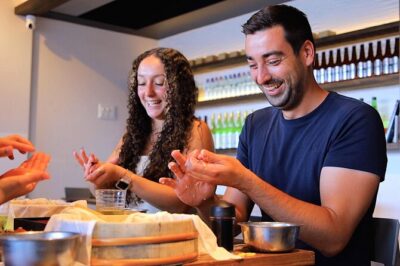
Sushi Making Osaka Roll and Authentic Japanese Sushi Class
Read our review →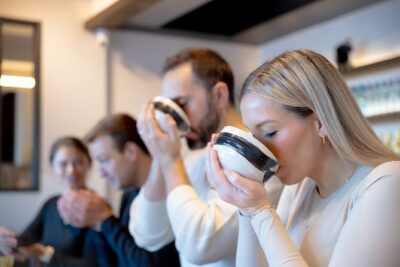
Matcha Making Class in Osaka with Authentic Japanese Sweets Set
Read our review →
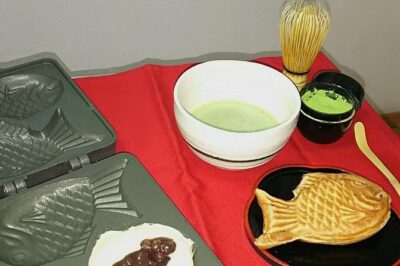
Osaka Cooking Class: Okonomiyaki &Japanese cuisines experience
Read our review →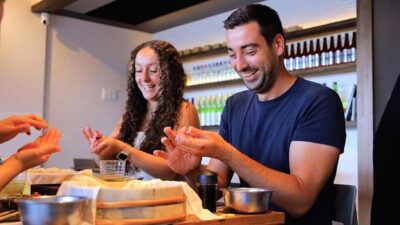
Roll and Authentic Sushi Making Class in Dotonbori
Read our review →

Browse the lists this tour appears in