
Reviewed · NARA DAY TRIPS FROM OSAKA
Nara Early Morning Tour (Osaka Departure Option)
Nara is at its best early, when the deer are active, the temple grounds are calmer, and your photos do not have to fight through an afternoon crowd. This 4.5-hour walking tour covers Kofuku-ji, Kasuga Grand Shrine, Nara Park, and Todaiji Temple, with an English-speaking guide and the train fare from Osaka included.
I like the small group limit of eight, which gives guides such as Koh, Lin, and Soichiro room to explain what you are seeing. I also like the smart finish at Kintetsu Nara Station before noon, leaving your afternoon open. The catch is simple: you walk about 10,000 steps, use public transportation, and must pay your own way back to Osaka.
Key points at a glance
- Early start, quieter Nara: Visit the main sights before the afternoon crowds arrive.
- Four major stops: See Kofuku-ji, Kasuga Grand Shrine, Nara Park, and Todaiji Temple in one morning.
- Small group format: The tour accepts up to eight people, with guides including Koh, Lin, and Soichiro.
- Osaka to Nara fare included: The outward transportation cost is covered, but your return fare is not.
- Ends before noon: Finish at Kintetsu Nara Station with time for more Nara, Osaka, or Kyoto.
- A real walking tour: Expect roughly 10,000 steps, with no private vehicle.
Why an early Nara start makes sense
Nara is easy to reach from Osaka, but the popular sights can feel very different at 8 or 9 in the morning than they do later in the day. The early timing is the main reason to choose this experience. You get to the temples and park before the heaviest afternoon flow, when photos are easier and the grounds feel less hurried.
This is not a vehicle tour that carries you from gate to gate. You meet at the Osaka Tourist Information Center in the central concourse of JR Osaka Station, then travel by public transportation to Nara. From there, you walk between the sights. That means more effort, but also a better sense of how Nara fits together.
The group can include no more than eight people. That is a useful size for a city walk. You are not lost in a large crowd, and the guide can answer questions without trying to reach thirty people at once. The guides named in the feedback include Koh, Lin, and Soichiro. Koh helped one family with directions for the return trip, while Lin and Soichiro were praised for being helpful, pleasant, and well informed.
More Nara day trips from Osaka:
- Ancient Capital Tour: Kyoto and Nara Highlights from Kyoto/Osaka
★ 4.5 · 332 reviews - Kyoto and Nara Day Trip from Osaka
★ 4.0 · 175 reviews - Discover Himeji, Kobe and Nara from Osaka
★ 5.0 · 101 reviews
Kofuku-ji and Nara’s first temple views
Kofuku-ji is the first listed stop, with about an hour here. The temple was founded in Nara in 710, the same year the city became Japan’s capital. That date gives you a useful starting point: Nara is not simply an old town with a few famous buildings. It was built as an imperial capital, and its major temples were tied closely to the country’s early political and religious life.
The five-story pagoda is Kofuku-ji’s most familiar sight. It is the second-tallest wooden pagoda in Japan, only seven meters shorter than the tallest. Even if you know little about Buddhist architecture, its proportions make an immediate impression.
The listed admission for this stop is free. Your guide can help put the buildings and symbols into context, which matters here because Kofuku-ji is more than a quick photo stop. You are seeing one of the temples connected with Nara’s first days as a capital.
The exact amount of time at each stop can shift with the pace of the group. Still, the planned hour is enough to look around without turning the first temple into a rushed glimpse. Wear shoes you can walk in comfortably, since this visit is part of a morning on foot rather than a short hop between parking areas.
Kasuga Grand Shrine and its thousands of lanterns
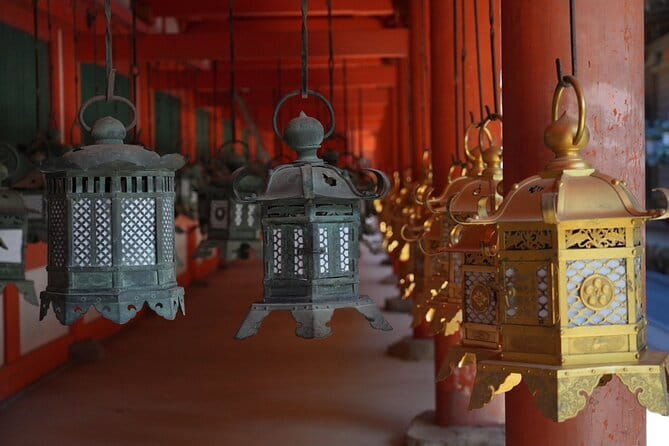
Kasuga Grand Shrine is the most atmospheric stop on the route for many people. It is known for roughly 3,000 stone and bronze lanterns donated by worshippers. The lanterns give the shrine a strong visual identity, and they also show how religious places were supported over time by people who came to pray.
The tour allows about an hour here, and admission is included. That removes one small decision during the morning, letting you focus on the shrine grounds and the guide’s explanation.
Kasuga is also important to the story of Nara’s deer. The shrine’s tradition says that one of its four gods came to Nara riding a deer. That belief helps explain why the animals are treated as sacred rather than simply as park wildlife.
You may find this stop especially rewarding if you care about the meaning behind what you photograph. The lanterns are attractive on their own, but the guide can connect them to the shrine’s worship and to the role deer play in Nara’s identity. As with every stop, the early hour helps. A calmer approach to the shrine gives you more room to notice the details.
Nara Park and the famous deer
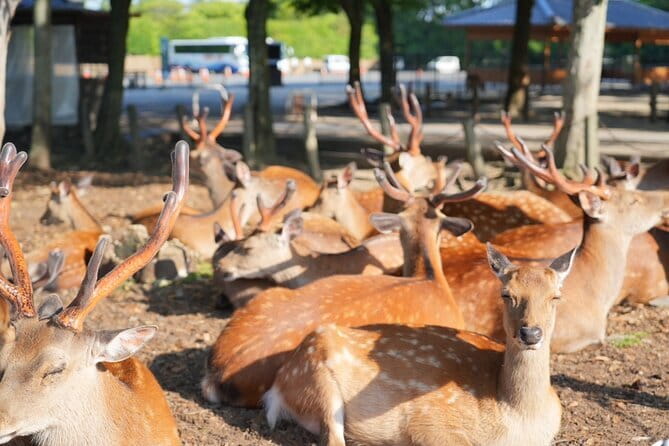
Nara Park is the most playful section of the morning. The park is home to thousands of wild deer, and the animals are one of the clearest reasons people add Nara to an Osaka trip. They are not presented merely as a cute attraction. Their connection to Kasuga Grand Shrine gives them a sacred place in local tradition.
You have about an hour in the park. That should give you time to watch the deer, take photographs, and move between the park and the nearby sights with the group. The deer are wild, so it is best to treat them as animals with their own behavior rather than as props. Keep your attention on the guide’s instructions and on the animal in front of you.
This part of the tour can be a hit with families, first-time visitors to Japan, and anyone looking for a lighter break between temple visits. It also gives you a change of pace. Kofuku-ji and Kasuga Grand Shrine ask you to look closely at buildings, religious objects, and history. Nara Park gives you a chance to simply watch what is happening around you.
The early start is useful here too. You have a better chance of enjoying the park before the largest wave of day visitors arrives. You should still expect walking and occasional pauses as the group moves around the animals. This is not a controlled animal encounter, and that is part of what makes it memorable.
A few more Osaka half-days worth pricing up
- Osaka Early Morning Tour with English-Speaking Guide Dotonbori
★ 5.0 · 110 reviews - Osaka Morning Tour: Shitennoji Temple, Shinsekai &Doutonbori
★ 5.0 · 23 reviews - Osaka: Early Morning Osaka Castle Guided Tour, Avoid Crowds
★ 4.9 · 12 reviews - Osaka Early Morning Osaka Castle Tour Avoid Crowds
★ 5.0 · 3 reviews
Todaiji Temple and the Great Buddha
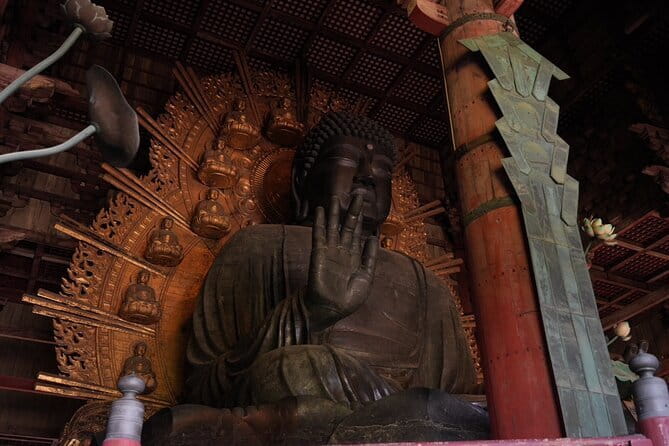
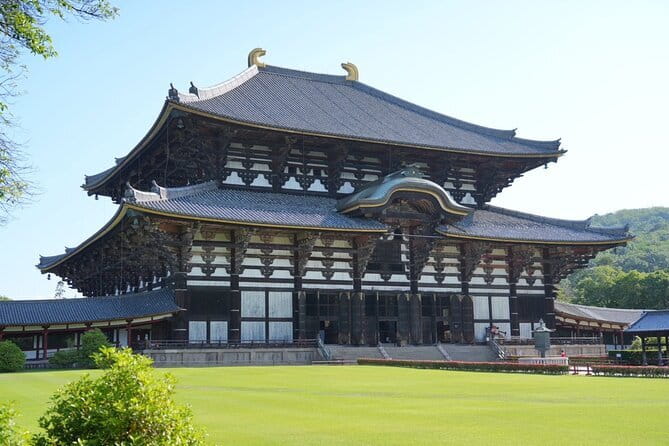
Todaiji is the grand finale, with about an hour planned for the visit. The temple is famous for its Great Buddha, described as the biggest Buddha statue in Japan. Its main hall was, until recently, the world’s largest wooden building.
Those facts give you a sense of scale before you enter. The building is not impressive only because of its age or religious importance. Its size changes how you experience the space. You look up, across, and around in a way that is quite different from a small neighborhood temple.
Admission to Todaiji costs 800 yen and is not included in the tour price. This is the key extra expense to plan for during the morning. The other listed admission, Kasuga Grand Shrine, is included, while Kofuku-ji and Nara Park are free.
Todaiji is also where the guide’s role can be most useful. A huge statue and hall are easy to photograph, but their meaning can slip past you if you do not know what you are looking at. A guide can help connect the building, the Buddha, and Nara’s early role as a capital without making you sort through the details alone.
After Todaiji, the tour concludes at Kintetsu Nara Station. It does not return you to Osaka. That is not a flaw for every visitor, since the station puts you in a good position to keep exploring, but you need to understand the plan before booking.
What the Osaka departure means for your day

The meeting point is the Osaka Tourist Information Center at JR Osaka Station, in the central concourse at 3-chome 1, Umeda, Kita Ward. The Osaka to Nara transportation fee is included. The return fare is not.
Because the tour starts early and ends before noon, you can use the rest of the day in several ways. You might continue exploring Nara on your own, return to Osaka, or travel onward to Kyoto. The open afternoon is one of the tour’s strongest practical features. It lets you see Nara without giving up a full day elsewhere.
You need to arrive on time. Latecomers are not granted a refund, and the tour depends on public transportation and a fixed morning route. Leave enough time to find the meeting point inside the station rather than arriving at the last minute.
The mobile ticket is convenient, but it does not change the basic rule: check the meeting details carefully and keep your phone available. Confirmation is sent at booking.
Is $87.96 a fair price?

At $87.96 per person, this is not the cheapest way to see Nara. You are paying for an English-speaking guide, the organized route, and the outward transportation from Osaka. The admission fee for Todaiji, 800 yen, is extra, as are food, drinks, personal purchases, and your return transportation.
The value depends on how much help you want. If you are comfortable reading train signs, planning the route, and learning about each temple from your own guidebook, you can spend less by going independently. You also gain more freedom that way.
I see the price as easier to justify for a first visit, especially if you want the main sights handled in one morning. Nara’s attractions are spread across a walkable but sizable area, and the guide keeps the route moving while explaining what matters. The group limit of eight makes the cost more appealing than a large bus outing.
The best value comes from the time saved. You see four major places before noon, then decide how to use the rest of the day. If you would otherwise spend hours working out transportation and the order of the sights, the organized morning may be worth the extra cost.
The walking level and who should book
The tour involves about 10,000 steps and requires a moderate level of physical fitness. That is the most important practical detail after the early start. You should be ready to walk between temples, through park areas, and along the route using public transportation rather than a private vehicle.
This suits you if you want a focused introduction to Nara, prefer a small group, and like having a guide explain cultural details as you go. It is also a good match if you want to keep the afternoon open for Osaka or Kyoto.
Think twice if you want a slow morning, dislike fixed meeting times, or prefer to spend long stretches inside one temple. The route gives each main stop about an hour, so it offers breadth rather than extended time at a single site.
Families can find the deer and Great Buddha especially engaging, though the walking total is still real. If you have limited mobility, the stated moderate fitness requirement deserves careful attention before booking. The available information does not promise a private vehicle or a customized pace.
What the guide adds to the morning
The strongest human part of this experience is the guide. Koh, Lin, and Soichiro are the names associated with the tour’s feedback, and the comments point to a helpful, well-prepared style.
Koh was singled out for useful information and for helping a family understand how to get back from Nara. That matters because the tour ends at Kintetsu Nara Station rather than at your Osaka starting point. Soichiro was praised for adding depth to the sights and for being pleasant company. Lin was described as helpful and informative during a first visit to Japan.
A small group also changes the tone. You can ask a question at Kofuku-ji, pause for a deer photo, or clarify the train plan without trying to catch a guide’s attention across a large crowd. The guide cannot remove the walking or the early start, but can make the morning easier to follow.
A few things to plan before you go
Bring enough water for a half-day walk, since food and drinks are not included. You may also want to plan where you will eat after the tour, as it ends before noon and personal expenses are your responsibility.
Allow extra time to find the Osaka Tourist Information Center. JR Osaka Station is large, and a punctual tour does not leave much room for getting lost. Once the group reaches Nara, follow the guide’s pace and remember that the route is designed to cover four major places in a limited morning.
Keep 800 yen in mind for Todaiji admission, plus the fare back from Kintetsu Nara Station. If you plan to continue to Osaka or Kyoto, the station finish gives you flexibility, but that onward transportation is yours to arrange and pay for.
Cancellation is free if you cancel at least 24 hours before the start time. Cancellations or changes made within 24 hours are not refunded or accepted.
Should you book the Nara morning tour?
Book it if you want to see Nara’s essential sights early, prefer a guide to traveling alone, and value having your afternoon free. The strongest reasons are the small group, the early timing, the four-stop route, and the help with a return journey that you arrange yourself.
Skip it if you want a private vehicle, a slow custom schedule, or the lowest possible cost. You will walk about 10,000 steps, pay 800 yen for Todaiji, and make your own way back after the tour.
For a first Nara visit from Osaka, I find the plan sensible and well focused. Start early, see the deer before the day gets crowded, hear the stories behind the lanterns and temples, then finish at Kintetsu Nara Station with most of the day still ahead.
FAQ
Where does the Nara tour start?
It starts at the Osaka Tourist Information Center in the central concourse of JR Osaka Station, at 3-chome 1, Umeda, Kita Ward, Osaka.
Where does the tour end?
The tour ends at Kintetsu Nara Station in Nara.
Is transportation from Osaka to Nara included?
Yes. The transportation fee from Osaka to Nara Station is included. The fare for returning from Nara is not included.
Does the tour return to Osaka?
No. It concludes at Kintetsu Nara Station, so you make your own arrangements and pay for transportation back to Osaka or onward to another destination.
How long does the experience last?
The tour lasts approximately 4 hours and 30 minutes and finishes before noon.
Which places are visited?
The route includes Kofuku-ji Temple, Kasuga Grand Shrine, Nara Park, and Todaiji Temple.
Is Todaiji admission included?
No. Todaiji admission costs 800 yen. Kasuga Grand Shrine admission is included, while Kofuku-ji Temple and Nara Park have no listed admission charge.
How large is the group?
The tour has a maximum of eight people.
Just added in Osaka
- Urban Canvas: Osaka Street Art Bike Tour★ 5.0 · 10 reviews
- Anime Cosplay Photshoot-50 Digital Photos Provided★ 5.0 · 8 reviews
- TeamLab Botanical Garden Osaka Ticket★ 3.5 · 6 reviews
- Umeda Sky Building & Kuchu Teien Observatory Ticket in Osaka★ 4.5 · 3 reviews
- Immerse in Judo Martial Arts Class from Japan★ 5.0 · 4 reviews
- Cherry Blossom Buddha and Mt.Yoshino with Strawberry Picking Tour★ 4.5 · 5 reviews
- Traditional Home cooking Experience in Osaka, Japan★ 5.0 · 14 reviews
- Traditional Calligraphy Experience near Dotonbori★ 5.0 · 3 reviews
Nara Day Trips from Osaka, compared.
Ancient Capital Tour: Kyoto and Nara Highlights from Kyoto/Osaka
Read our review →
Kyoto & Nara Private customized tour with English speaking Guide
Read our review →
Kyoto and Nara UNESCO Highlights Full-day Tour From Osaka
Read our review →
Kyoto & Nara & Uji: Full Day Sightseeing Tour from Osaka or Kyoto
Read our review →Browse the lists this tour appears in