
Reviewed · OSAKA CASTLE TOURS
Full Day Walking Tour in Osaka Castle Temples and Ukiyoe
Osaka is easiest to understand when you see its grand past and its noisy, ordinary present on the same day. This tour links Osaka Castle and Shitennoji Temple with Kuromon Market, Dotonbori, Shinsaibashi, and a hands-on ukiyo-e experience, giving you a broad look at the city rather than one isolated sight.
I like the way the tour mixes major landmarks with local street life, and I like that train tickets, admission fees, and ukiyo-e costs are included. Guides such as Wingki have also shown real patience, helping with meeting-point confusion and answering first-time Japan questions. The main drawback is the pace: eight hours of walking, trains, temples, markets, and city streets can feel demanding, especially if you want a slow meal at every stop.
Key points to know before booking
- Two very different Osakas in one day: See the castle and temple district, then move into the food, shopping, and entertainment quarters.
- Osaka Castle Museum is included: The visit covers the castle’s story and its repeated destruction and rebuilding.
- Shitennoji adds ancient Buddhist context: You learn how Buddhism traveled from India through China before reaching Japan.
- Kuromon Market is for browsing and eating: About 150 shops sell seafood, produce, prepared food, drinks, clothing, and more.
- Ukiyo-e gives you something to do, not just see: The tour includes a traditional art activity in the Dotonbori area.
- The group can reach 20 people: Some departures may be much smaller, but you should not book expecting a private tour.
Why this route works for a first day in Osaka
Many Osaka tours focus almost entirely on food or neon-lit Dotonbori. This one gives you a stronger sense of time and place. You begin with the city’s political and religious past, then finish among markets, signs, shops, and entertainment streets.
That contrast is the best reason to book. Osaka Castle can feel formal and monumental. Shitennoji is quieter and tied to the arrival of Buddhism in Japan. Later, Kuromon Market and Dotonbori show how Osaka built its identity around trade, eating, shopping, and plainspoken urban energy.
You will spend about eight hours on the move. The route uses trains, and the required train tickets are included. That matters because Osaka’s major sights are spread across different areas, and sorting out the correct fare can slow down a first visit.
The tour has a maximum group size of 20. That is not the same as a private tour, but the guide-led format lets you ask questions as you go. Wingki, also written as Wingi or Winki in the supplied guide information, is specifically associated with warm, flexible guiding. One participant arrived late after getting lost, and the guide still helped the day get back on track. That kind of personal attention can be useful when you are finding your feet in Osaka.
More ways to see Osaka Castle:
- Osaka Castle: Museum and Tower Entry Ticket
★ 4.5 · 2,380 reviews - Osaka Castle Walking Tour and Castle Tower Admission
★ 5.0 · 561 reviews - 5-Hour Osaka Bike Tour to the Neighborhood of Osaka Castle
★ 5.0 · 319 reviews
Osaka Castle and the 1597 story
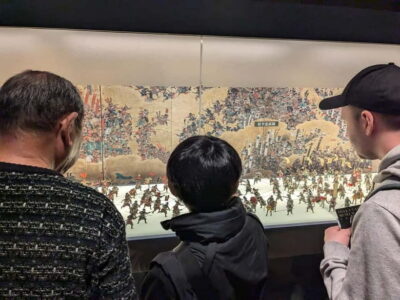
The day begins at Osaka Castle, with about two hours allocated to the castle museum and surrounding area. Admission is included, so you can focus on the displays rather than sorting out another ticket.
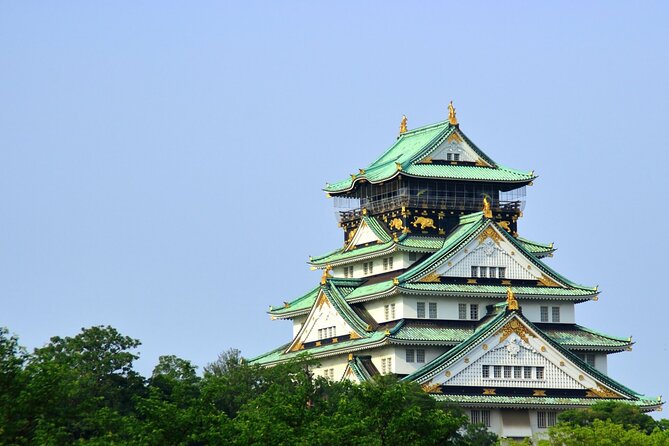
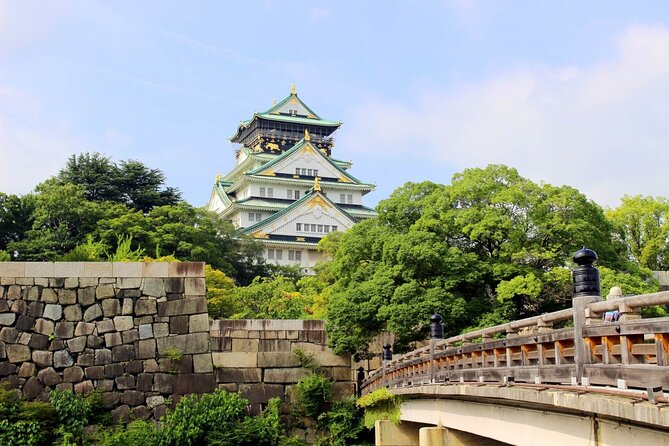
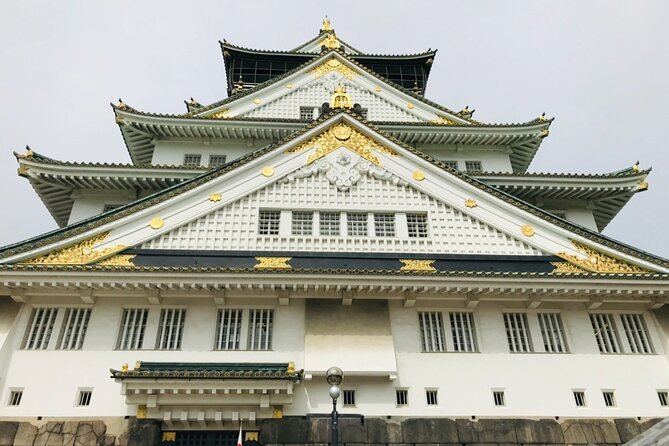
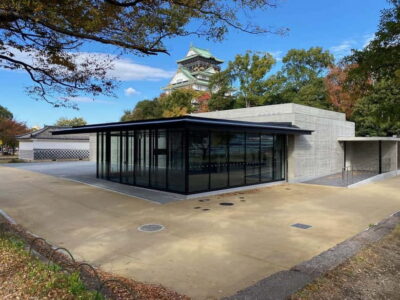
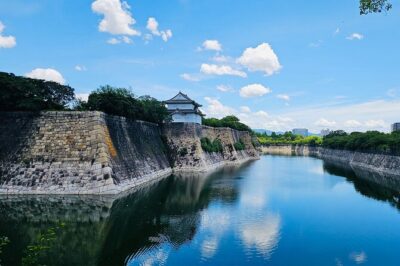
The present castle is not the original structure. The first castle was completed in 1597, then destroyed and rebuilt several times. The current version was rebuilt by the Japanese government in 1995, so its appearance differs from the castle that originally shaped Osaka’s history.
That distinction is worth keeping in mind. You are not entering an untouched medieval fortress. You are visiting a modern reconstruction that presents the story of the earlier castle, the city, and the people connected with it. A guide can help separate the physical building from the events it represents.
I like this part of the tour because it gives Osaka a clear starting point. The castle is not just a photogenic stop. It helps explain why Osaka became such an important city and why the area has carried political weight for centuries.
The two-hour block is useful for a first visit, though it is not a leisurely castle day. If you want to study every display in detail or spend a long time taking photos around the grounds, you may wish for more time. The tour is designed to keep moving toward the next district.
Shitennoji and Buddhism’s route to Japan
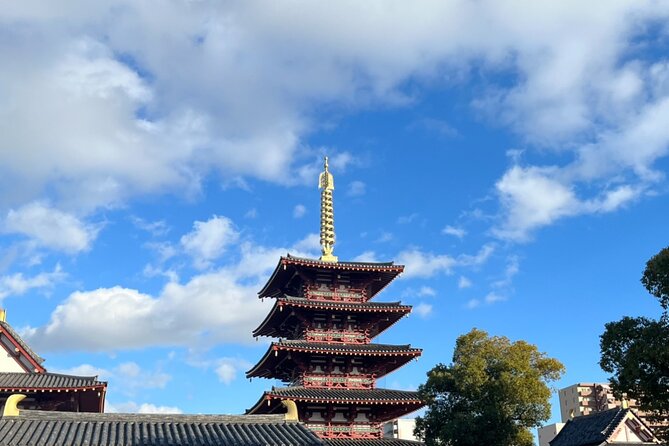
After Osaka Castle, the tour heads to Shitennoji Temple for another two-hour section. The temple is described as Japan’s first Buddhist temple, making it an important stop for understanding the country’s religious past.
The most valuable part here is the larger story. Buddhism began in India, moved through China, and eventually reached Japan. Shitennoji gives your guide a place to explain that movement in a concrete setting rather than as a list of dates from a textbook.
This is also a useful counterpoint to Osaka Castle. The castle reflects power, warfare, and government. Shitennoji points toward religion, community, and the long exchange of ideas across Asia. Taken together, the two stops make the morning feel more complete.
The temple visit also helps break up the day. After a museum and castle complex, the change of setting can be welcome. Still, you should expect more walking and standing. The tour is not built around long rest periods, and the full day works best if you are comfortable being on your feet.
Kuromon Market, where lunch is your choice
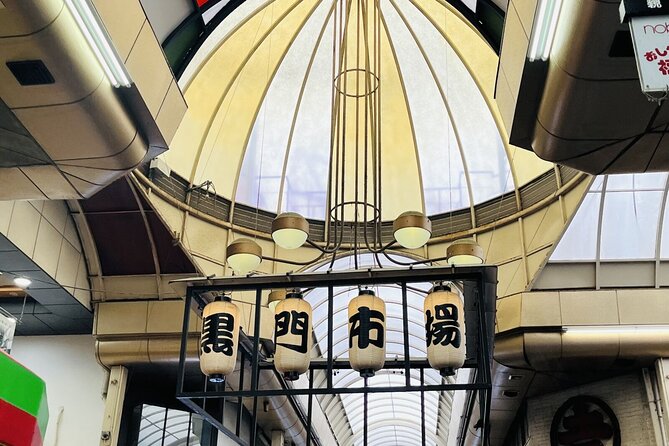
The next stop is Kuromon Market, with about one hour set aside. The market stretches roughly 580 meters and has about 150 shops selling fresh seafood, vegetables, fruit, prepared food, drinks, clothing, and other goods.
Food and drinks are not included in the tour price. That is a drawback for anyone hoping for an all-inclusive food tour, but it also gives you control. You can choose how much to spend and what to try instead of being locked into a set menu.
One hour is enough to browse and buy a snack or small meal, but it is not a long market crawl. Kuromon can be tempting, particularly if you stop at several stalls. Keep an eye on the time, since the group still has Dotonbori and the ukiyo-e activity ahead.
I would treat this as a chance to sample Osaka, not as the main food event of the day. You are likely to see seafood, produce, sweets, drinks, and everyday goods in a compact area. The market adds a practical, working-city feel that a castle and temple alone cannot provide.
Because food is extra, the tour price is easier to judge if you think of it as a sightseeing day with a flexible lunch stop. You are paying for the guide, entries, train fares, and art activity, then choosing your own meal.
More temple tours in Osaka:
- Osaka: Minoh, Katsuoji Temple, & Minoh Falls Full-day Tour
★ 4.9 · 172 reviews - Osaka Temple Cool Foot Bath & Matcha Experience〈45min〉
★ 4.9 · 82 reviews - Osaka: Mind & Spirit Balance Temple Reiki Healing
★ 5.0 · 41 reviews - Katsuo-ji Temple, Arashiyama Forest, & Nara Park
★ 4.0 · 37 reviews
Dotonbori, a shrine, and Osaka’s famous signs
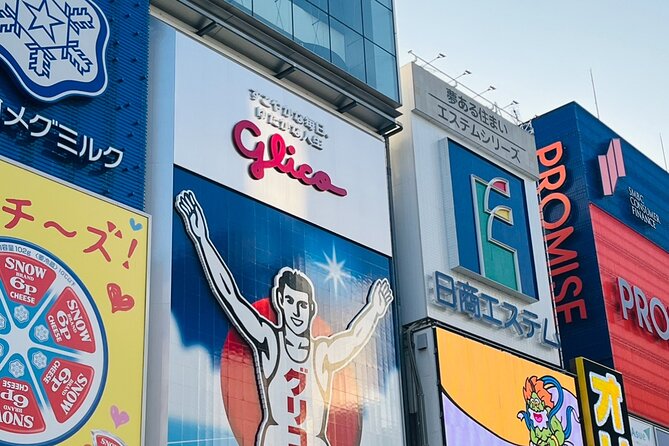
The final three-hour section covers Dotonbori, a nearby shrine, ukiyo-e, and a walk through Shinsaibashi before returning toward Osaka and Shin-Osaka Station.
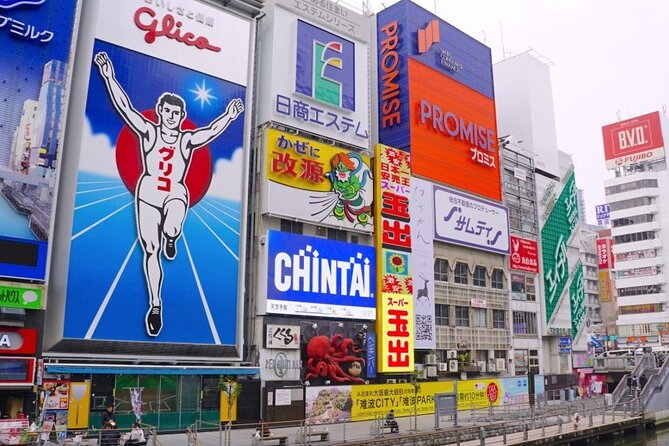
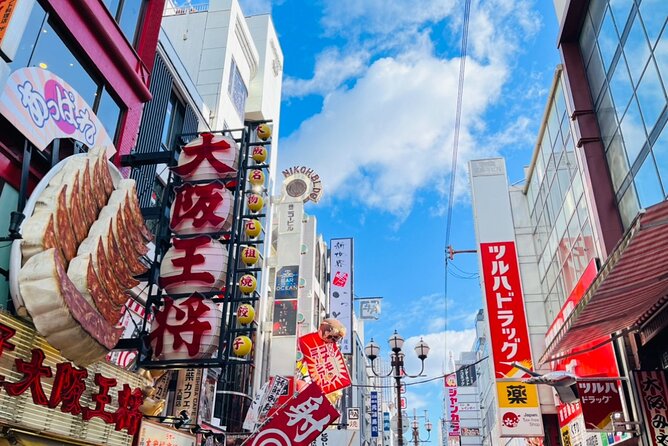
Dotonbori is the symbolic commercial and downtown area of Minami, Osaka. Its giant three-dimensional signs are part of the city’s visual identity, and the district is strongly tied to food and nightlife. Even if you have seen pictures of the area, walking through it with a guide can help you understand how it fits into Osaka’s wider city center.
The schedule says the tour heads to a unique shrine after the market, then spends time in Dotonbori. The supplied details do not identify the shrine by name, so you should not expect a separate, highly specific shrine itinerary. Think of it as an additional cultural stop within the wider neighborhood visit.
The guide’s role matters here. Dotonbori is easy to photograph, but less easy to interpret. A local English-speaking guide can answer questions, point out contrasts between the shopping streets, and help you make sense of the area beyond its oversized signs.
The final walk through Shinsaibashi takes you along Osaka’s main shopping area. This gives the day a natural finish, shifting from history and food into retail and city life. It also means the last section can feel especially active after several earlier stops.
The ukiyo-e activity adds a hands-on pause
Ukiyo-e is one of Japan’s best-known traditional art forms. The earliest works mentioned for the form date to the 1670s, and it flourished from the 17th through the 19th centuries.
The tour includes an ukiyo-e experience fee, so this is more than a quick explanation beside a display. You get a chance to take part in an activity connected to the art itself. The exact process and finished item are not specified, so it is sensible to view this as an introduction rather than a full art course.
I like this inclusion because it changes the rhythm of the day. Most sightseeing asks you to look, listen, and move on. Ukiyo-e gives you a chance to do something with your hands and leave with a more direct connection to a Japanese art tradition.
It is also a good feature for people who have already seen several temples and museums. The activity keeps the afternoon from becoming a string of photographs and guide commentary.
What the $165.19 price includes
At $165.19 per person, this is not a cheap walking tour. The value depends on how much help you want during a full day in a large city.
The price includes entrance fees for each listed stop, train tickets needed during the tour, the ukiyo-e experience, and an English-speaking guide. Those inclusions remove several small costs that can add up. They also save you time at ticket counters and train machines.
Food and drinks are not included. You should set aside extra money for Kuromon Market and anything you buy in Dotonbori or Shinsaibashi. The flexible spending is useful if your appetite and budget do not match those of the rest of the group.
For me, the tour offers fair value if you are visiting Osaka for the first time and want one organized day covering several districts. It is less compelling if you already know Osaka’s train system, prefer to choose each meal yourself, or want to spend a whole day at one major sight.
The strong point is the range: castle, temple, market, downtown streets, shopping, and art. The tradeoff is that no single stop receives unlimited time.
Who will get the most from this day
I would recommend this tour to a first-time Osaka visitor who wants context as well as photos. You get an English-speaking guide, a structured route, and help moving between areas that are not all next door to one another.
It also suits anyone who likes asking questions. The guide team’s recorded strengths are patience, enthusiasm, and personal attention. Wingki in particular is associated with answering many questions for a first visit to Japan and adjusting to unexpected delays.
The tour may also suit couples, friends, and solo visitors who want company for a long day. The maximum group is 20, so the experience is not guaranteed to be intimate. If your booking happens to be small, you may receive more direct time with the guide, but that should be treated as a possibility rather than a promise.
I would think twice if you dislike fixed schedules, long walks, or busy commercial districts. The itinerary covers a lot of ground, and the final hours in Dotonbori and Shinsaibashi can feel full after the morning’s historical stops.
The tour is near public transportation, and most people can participate. Still, the eight-hour length is the key practical issue. Wear comfortable shoes and keep your plans for that evening light.
Booking details and cancellation
Confirmation is provided at booking, and the experience uses a mobile ticket. It is often booked about 65 days in advance, so early planning is sensible if your Osaka dates are fixed.
Free cancellation is available up to 24 hours before the start time for a full refund. Cancellations or changes made within 24 hours are not accepted for a refund, and the cut-off follows local Osaka time.
The activity is operated by Snow Monkey Resorts Tours, part of Machinovate Japan Ltd. The tour can be booked for up to 20 people.
Should you book this Osaka tour?
Book it if you want one organized day that explains Osaka from several angles. The combination of Osaka Castle, Shitennoji, Kuromon Market, Dotonbori, Shinsaibashi, and ukiyo-e gives you more range than a basic city highlights walk.
I especially like the included train fares and admissions, the hands-on art activity, and the chance to ask a local English-speaking guide about Japan as you go. The main caution is the pace. You will pay extra for food, walk for much of the day, and have limited time at each stop.
If that sounds like a fair trade for a well-planned introduction, this is a useful first-day choice. If you want a slow food crawl or a private, unhurried castle visit, choose a narrower tour instead.
FAQ
How long does the Osaka walking tour last?
The tour lasts approximately eight hours.
What sights are included?
The route includes Osaka Castle, Shitennoji Temple, Kuromon Market, the Dotonbori area, a nearby shrine, Shinsaibashi, and an ukiyo-e experience.
Is admission to Osaka Castle included?
Yes. Admission fees for the stops during the tour are included.
Are train tickets included?
Yes. The train tickets required for the tour are included in the price.
Is food included?
No. Food and drinks are not included. You can purchase food and drinks at your own cost, including during the Kuromon Market stop.
Is the ukiyo-e activity included?
Yes. The ukiyo-e experience fee is included.
Does the tour have a group-size limit?
Yes. The maximum group size is 20 people.
Can I cancel for a full refund?
Yes, if you cancel at least 24 hours before the experience start time. Cancellations made less than 24 hours before the start time are not refunded, and changes within that period are not accepted.
More Full-Day in Osaka
- Osaka’s Best and Brightest: Private Full-Day Tour by Vehicle
★ 5.0 · 147 reviews - Full Day Tour of Kyoto with Private Transportation
★ 5.0 · 130 reviews - Full Day Hiroshima and Miyajima Tour by Bullet Train from Osaka
★ 4.5 · 117 reviews - Amanohashidate & Ine Funaya Sightseeing Full Day Trip from Kyoto
★ 4.5 · 62 reviews
More Walking Tours in Osaka
- Osaka Local Foodie Walking Tour in Dotonbori and Shinsekai
★ 5.0 · 985 reviews - Osaka: Deep Backstreets Walking Tour with Dinner Option
★ 4.9 · 902 reviews - Ultimate Osaka Walking Tour: Castle, Dotonbori & Hidden Gems
★ 5.0 · 862 reviews - Osaka: Main Sights and Hidden Spots Guided Walking Tour
★ 4.9 · 702 reviews
Just added in Osaka
- Urban Canvas: Osaka Street Art Bike Tour★ 5.0 · 10 reviews
- Anime Cosplay Photshoot-50 Digital Photos Provided★ 5.0 · 8 reviews
- TeamLab Botanical Garden Osaka Ticket★ 3.5 · 6 reviews
- Umeda Sky Building & Kuchu Teien Observatory Ticket in Osaka★ 4.5 · 3 reviews
- Immerse in Judo Martial Arts Class from Japan★ 5.0 · 4 reviews
- Cherry Blossom Buddha and Mt.Yoshino with Strawberry Picking Tour★ 4.5 · 5 reviews
- Traditional Home cooking Experience in Osaka, Japan★ 5.0 · 14 reviews
- Traditional Calligraphy Experience near Dotonbori★ 5.0 · 3 reviews
Osaka Castle Tours, compared.
Osaka Castle Walking Tour and Castle Tower Admission
Read our review →
5-Hour Osaka Bike Tour to the Neighborhood of Osaka Castle
Read our review →

PRIVATE 6hr, Food tour from Osaka Castle, Kuromon, Dotonbori.
Read our review →
A Tour to Explore the Symbol of Osaka: Osaka Castle
Read our review →
Learning Zen of Japanese Calligraphy in kimono near Osaka Castle
Read our review →Browse the lists this tour appears in