
Reviewed · DINNER EXPERIENCES
Deep Backstreet Osaka Tours (Option to add Dinner)
Osaka’s most revealing sights are not the neon signs of Dotonbori. They are the narrow lanes, abandoned homes, family food stalls, places of worship, and districts carrying stories that rarely reach a standard sightseeing route. This evening walk takes you into that less polished side of the city, including a former ghetto and a historic red-light district.
I like the small-group format, capped at 15 people, and the way the guides connect food with larger subjects such as class, religion, homelessness, sex work, and organized crime. I also like the choice of dinner, which turns a good walking tour into a full night out with local dishes at an izakaya.
The main consideration is the subject matter. This is not a cheerful tour of Osaka’s bright side, and some stops may feel uncomfortable or sad. You will also walk for a little over three hours, with breaks, so good shoes and suitable weather matter.
Key points to know before booking
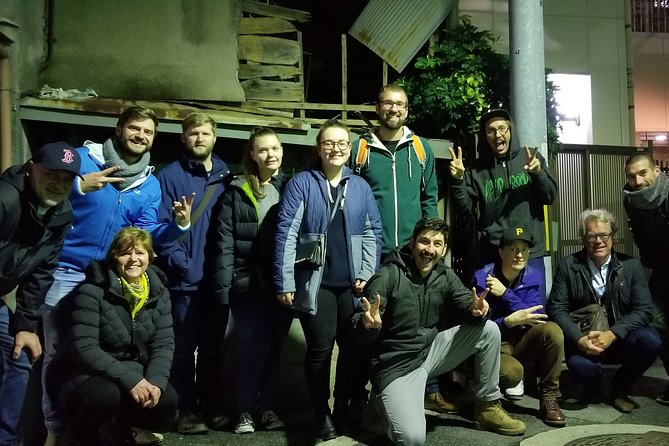
- A candid look at Osaka: Visit districts tied to homelessness, sex work, abandoned houses, social class, religion, and yakuza history.
- Two food stops: Try Osakan street food at family-run stalls during the walk.
- Dinner is optional: Add an izakaya meal with tonpeiyaki, karaage, nikudofu, yakitori, and dessert.
- Strong guide-led experience: Guides including Mari, Knox, Josh, Bennett, and others bring humor and clear explanations to difficult subjects.
- Three hours on foot: The route uses narrow backstreets and includes standing stops, so comfortable footwear is essential.
- Good value at $53.06: The base price suits anyone seeking local context rather than another standard sightseeing circuit.
Why this Osaka walk feels different
Many Osaka tours stay with the city’s easy-to-sell images: glowing signs, famous food streets, shopping arcades, and busy nightlife. This one asks you to look closer. It moves through areas where daily life, social pressure, old customs, and economic hardship are visible beside ordinary shops and homes.
That shift is the tour’s main value. You are not simply collecting unusual photo stops. You are given context for places you might otherwise pass without understanding. The guide explains why some homes remain empty, how family names and social class can affect a property’s future, and how certain districts developed their reputations.
The tone is serious at times, but it is not presented as a grim march. Guides such as Mari, Knox, Josh, Bennett, Mark, and Thomi are praised for combining clear explanations with humor and patience. The individual guide matters here because the route covers sensitive topics. A thoughtful guide can explain difficult issues without turning them into spectacle.
The group limit of 15 is useful. It is small enough for questions, but large enough that solo visitors can meet people from other countries. Several guides also offer help after the walk, including suggestions for bars, shopping, and entertainment areas. That makes the tour a practical first-night introduction to Osaka.
More dinner and dining experiences in Osaka:
- Osaka: Deep Backstreets Walking Tour with Dinner Option
★ 4.9 · 902 reviews - Osaka Umeda: PICCADILLY DINNER SHOW & NIGHTCLUB with Tasting
★ 4.8 · 49 reviews - Osaka: PICCADILLY PREMIUM DINNER SHOW&NIGHTCLUB with Tasting
★ 5.0 · 26 reviews
Meeting near Daikokucho Station at 5:30 pm
The meeting point is outside FamilyMart MYS Daikokucho Station, at 2-chome-5-16 Shikitsuhigashi in Naniwa Ward. The tour starts at 5:30 pm and finishes back at the same meeting point.
An evening start works well for this route. You see the neighborhoods shift from late afternoon into the first hours of nightlife, and the optional dinner fits naturally at the end. You should arrive with enough time to find the convenience store and organize yourself before the group leaves.
The activity uses a mobile ticket and is close to public transportation. Most people can participate, but this is still a walking tour with long periods on your feet. One person described it as a little over three hours, though the pace was easy and included breaks.
Bring comfortable shoes and water. In warm months, mosquito spray may also be useful. One stop involves standing in a park where mosquitoes were a nuisance, and another outdoor waiting area received a similar complaint. These are small matters, but they are worth knowing if you react badly to insects.
Narrow lanes, old houses, and Osaka’s retro side
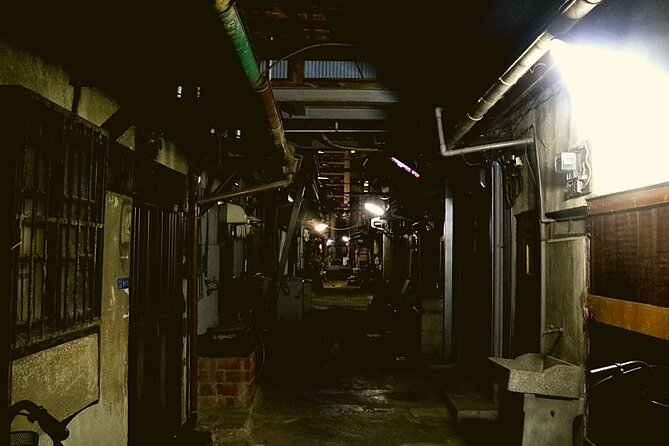
The first part of the route leads into old, twisting alleys. These lanes are a sharp contrast to Osaka’s broad commercial streets. You may see small businesses, aging buildings, unusual storefronts, and corners that are easy to miss without someone who knows the area.
The tour also passes through a retro zone with quirky and outlandish shops. This is a lighter section of the evening, but it still supports the larger theme: Osaka’s identity is not limited to its famous districts. The city’s character often appears in ordinary, slightly odd, and proudly local places.
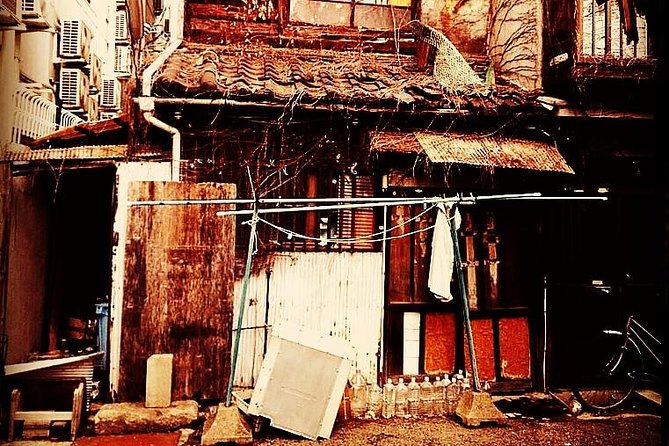
An abandoned houses area adds a more serious note. The guide explains how social reputation, family history, and the importance placed on a household name can affect whether a property is reused. The subject is particularly effective because it links a visible feature, an empty home, to an unseen part of Japanese society.
Do not expect to enter every building or receive a polished museum presentation. Much of the value comes from listening while looking at the street around you. The route is informal and outdoors, so the experience depends on the guide’s storytelling and your willingness to pay attention to details that might otherwise seem unremarkable.
Food stalls and the taste of everyday Osaka
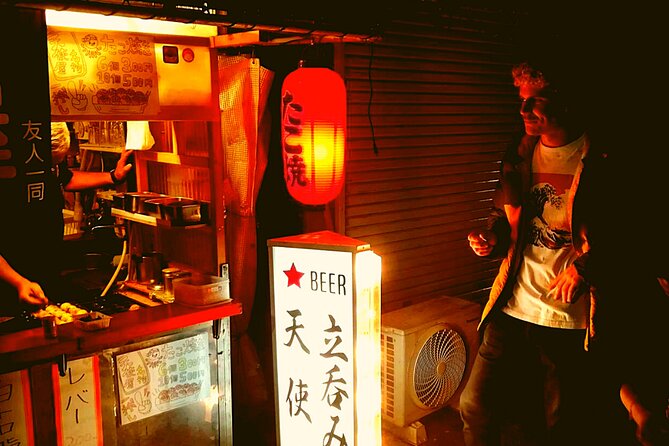
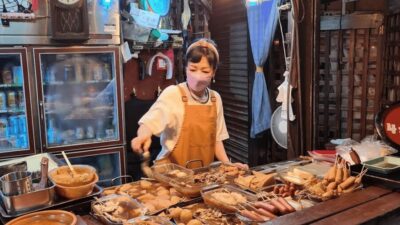
Food is woven into the walk rather than added as an afterthought. You stop at two family-run street stalls and taste local food along the way. The included food-stall tasting gives you a quick introduction to Osaka’s everyday eating culture without requiring a separate restaurant booking.
This is a useful part of the tour for first-time visitors. A guide can explain what you are eating, how it fits into local life, and where to look for similar food later. It also creates a welcome pause during a route that covers serious subjects.
The food portion is tasting-sized, not a full meal. If you choose the dinner upgrade, you receive a more substantial evening meal at an izakaya that is difficult to find without local help. Listed dishes include tonpeiyaki, karaage, nikudofu, yakitori, and dessert. The meal is described as vegetarian-friendly, but you should confirm your own dietary needs when booking or before the tour begins.
Alcohol is not included. Drinks at the restaurant are described as reasonably priced, so you can decide how much, if anything, you want to add. Keep in mind that food and drinks are best enjoyed after the walking portion, when you can sit down and relax.
Same city, a completely different kind of afternoon:
- Osaka Go Karting Tour with Funny Costume
★ 5.0 · 2,658 reviews - Osaka Castle: Museum and Tower Entry Ticket
★ 4.5 · 2,380 reviews - Osaka: Shinsekai Food Tour with 13-15 Dishes at 5 Eateries
★ 4.8 · 2,204 reviews - Osaka Food Tour: 13 Dishes at 5 Local Eateries
★ 5.0 · 2,149 reviews
A temple, a place of worship, and the meaning behind it
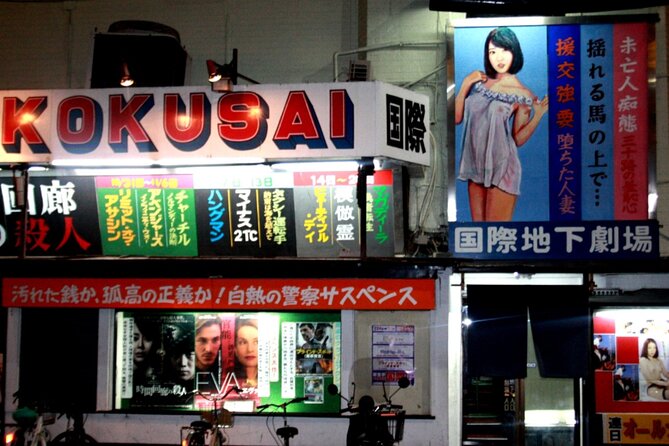
One of the route’s most interesting stops is an important but little-known place of worship. The guide explains what the site represents and how religion functions in present-day Japan.
This stop helps balance the darker material. The tour is not only about crime, poverty, or taboo subjects. It also looks at the beliefs and institutions that shape neighborhood life. A temple or shrine can seem decorative if you only stop for a quick photograph. With explanation, you begin to see why people visit, what rituals mean, and how these sites fit into the surrounding community.
The guide may also discuss how construction and maintenance are funded. That practical detail is easy to overlook, yet it helps you understand who supports local religious places and why certain buildings look the way they do.
You should be respectful here. This is an active place of worship, not a stage set, and the guide’s explanation is part of the experience. Keep voices low and follow any instructions about photography.
The red-light district and its difficult past
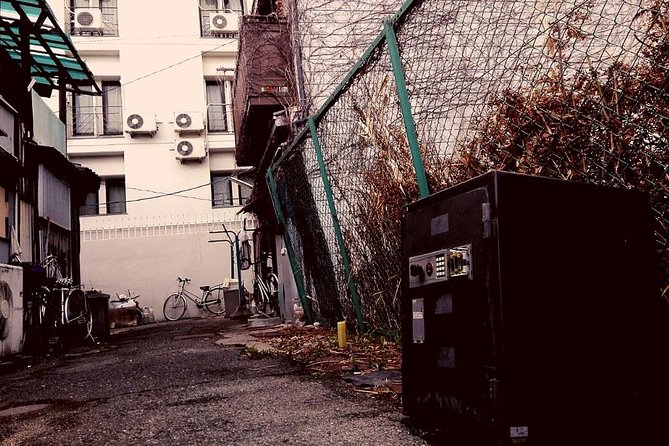
The route includes a historic red-light district with links to the yakuza. It also addresses sex work and the social rules that surround it. This section is likely to be the most confronting for some people, but it is handled as a lesson in local history and society rather than as entertainment.
You will not find a glossy nightlife tour here. The point is to understand how a district developed, how it is viewed, and why some parts of its past remain unspoken. The guide can also explain the difference between what a visitor sees on the street and what the area means to people who live and work nearby.
The walk is described as safe, but you still need to behave with care. Do not photograph people without permission, stare into businesses, or treat the neighborhood as a curiosity. The tour is strongest when it encourages respect rather than shock.
The former ghetto and Osaka’s social divisions
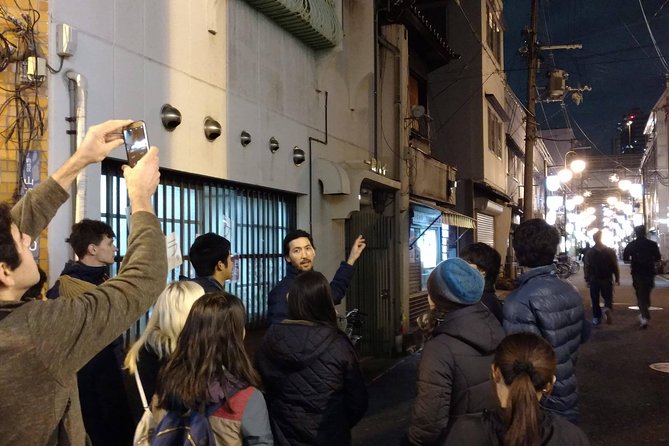
Another section covers a former ghetto with a controversial past. The guide connects this area to class, discrimination, mental health, homelessness, and the way certain communities have been treated over time.
This material may change the way you understand Osaka. Japan is often presented abroad as orderly and uniform, yet no society is free of exclusion or economic hardship. The tour gives you a chance to consider those contradictions without pretending they are simple.
The discussion of homelessness is especially useful because it moves beyond stereotypes. You hear about the circumstances that can push people out of stable housing and how the city responds. This is not a substitute for a full social history, but it gives you a starting point for thinking about what you see.
Some visitors may find this part emotionally heavy. That is not a flaw, but it is a reason to choose the tour carefully. If you want only food, shopping, and photogenic streets, another Osaka outing will suit you better.
The optional izakaya dinner
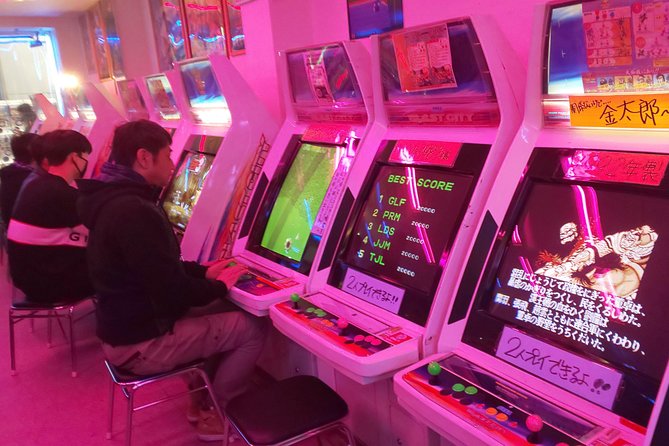
The dinner option is a strong reason to book this experience instead of a basic walking tour. After the route, you can sit down for Osaka soul food at a traditional izakaya. The meal includes dishes such as tonpeiyaki, karaage, nikudofu, yakitori, and dessert.
The setting matters as much as the food. An izakaya is the sort of place you might walk past without knowing what to order or how to fit in. Going with a local guide removes that barrier and lets you focus on eating and talking with the group.
I would choose the dinner if you want one complete evening and do not already have firm restaurant plans. It adds social time after the more serious walking sections, and the meal can be especially welcome after three hours on foot.
If you prefer to control your menu, budget, or timing, skip the upgrade. The base tour already includes food tasting, and the activity ends back at the starting point. Drinks are extra, and the exact dinner cost is not separately stated in the information provided, so check the booking choice carefully before paying.
Guide style and group atmosphere
The route covers complicated subjects, so the guide is central to the experience. The strongest guide descriptions point to people who are funny, patient, direct, and able to answer questions without hiding behind a script.
Mari is repeatedly praised for explaining difficult topics clearly and patiently. Knox is described as engaging and entertaining, while Josh is noted for mixing humor with detailed explanations of religion, class, gangs, and politics. Bennett is praised for his pacing and honest local information. Other guides, including Rudy, Alex, Mark, Thomi, Tommy, Rat, Kane, Nox, and Dillan, are also named in the feedback.
You should understand that the guide roster can change. You may not get the person you have read about, but the consistent pattern is clear: the experience depends on an outgoing guide who enjoys conversation.
The group size of up to 15 gives you a fair chance to ask questions. Solo visitors may also find the dinner and walking sections an easy way to meet people. The atmosphere can be lively, but the subjects call for maturity and discretion.
Is $53.06 a fair price?
At $53.06 per person, the base tour is reasonably priced for a three-hour guided walk with food tasting. You are paying for local interpretation, not costly entry tickets or major monuments. That distinction matters.
The value is highest if you want context you could not easily get from a map. The guide helps you read abandoned houses, religious sites, social boundaries, food stalls, and nightlife districts as parts of one city. A standard self-guided walk might show you the same streets, but it would not provide the connections.
The price becomes better still if you choose the dinner and would otherwise spend the evening finding an unfamiliar izakaya on your own. It is less attractive if you dislike walking, already know Osaka well, or want a conventional introduction to major sights.
The experience has a 4.9 rating from 1,290 reviews and a 97 percent recommendation rate. Those figures suggest a strong record, though your enjoyment will depend heavily on your interest in difficult social subjects and your guide’s style.
Who should book this Osaka experience?
I would recommend it to you if you have already seen, or plan to see, Osaka’s main shopping and food districts and want something more revealing. It suits curious visitors, solo adults, repeat visitors to Japan, and anyone interested in how cities deal with poverty, tradition, class, and nightlife.
It is also a good choice for people who learn best through conversation. The guide gives meaning to places that are easy to overlook, and the small group leaves room for questions.
I would think twice if you want a relaxed sightseeing stroll with constant photo opportunities. The route includes serious subjects, outdoor standing, narrow streets, and more than three hours of walking. It is safe according to the tour information, but it is not designed to make every stop feel comfortable.
Free cancellation is available up to 24 hours before the start time. Changes or cancellations inside that window are not refunded, and poor weather can lead to a new date or full refund. Since the experience depends on walking outdoors, check the forecast before committing.
Should you book Deep Backstreet Osaka Tours?
Book it if you want Osaka explained from the inside out, not just displayed under neon lights. The combination of family food stalls, old lanes, religious sites, abandoned homes, social history, and a red-light district creates a far more thoughtful evening than a standard city walk.
Choose the dinner option if you want a complete night with local food and built-in company. Skip it if you have restaurant plans or prefer to keep the evening flexible.
This is not a tour for everyone, and that is exactly why it is useful. If you are ready to listen to uncomfortable stories, walk beyond the usual route, and treat sensitive neighborhoods with respect, it can become one of your most memorable Osaka experiences.
FAQ
Where does the tour start?
It starts at FamilyMart MYS Daikokucho Station, located at 2-chome-5-16 Shikitsuhigashi, Naniwa Ward, Osaka.
What time does the tour begin?
The start time is 5:30 pm.
How long does the experience last?
The tour lasts approximately three hours. It involves walking with breaks along the way.
Where does the tour end?
The activity ends back at the meeting point.
How many people can join the tour?
The maximum group size is 15 people.
Is dinner included?
Dinner is optional. You can choose an upgrade that includes an izakaya meal.
What food is included during the walking tour?
The tour includes tasting food at a street stall. The route includes tastings at two family-run stalls.
What dishes are included with the dinner option?
The listed dishes include tonpeiyaki, karaage, nikudofu, yakitori, and dessert.
Are alcoholic drinks included?
No. Alcoholic beverages are not included, though drinks at the restaurant are described as reasonably priced.
Can I cancel for a full refund?
Yes, if you cancel at least 24 hours before the experience start time. Cancellations made less than 24 hours before the start time are not refunded.
Just added in Osaka
- Urban Canvas: Osaka Street Art Bike Tour★ 5.0 · 10 reviews
- Anime Cosplay Photshoot-50 Digital Photos Provided★ 5.0 · 8 reviews
- TeamLab Botanical Garden Osaka Ticket★ 3.5 · 6 reviews
- Cherry Blossom Buddha and Mt.Yoshino with Strawberry Picking Tour★ 4.5 · 5 reviews
- Umeda Sky Building & Kuchu Teien Observatory Ticket in Osaka★ 4.5 · 3 reviews
- Immerse in Judo Martial Arts Class from Japan★ 5.0 · 4 reviews
- Traditional Home cooking Experience in Osaka, Japan★ 5.0 · 14 reviews
- Traditional Calligraphy Experience near Dotonbori★ 5.0 · 3 reviews
Dinner Experiences, compared.
Deep Backstreets Walking Tour with Dinner Option
Read our review →
PICCADILLY PREMIUM DINNER SHOW&NIGHTCLUB with Tasting
Read our review →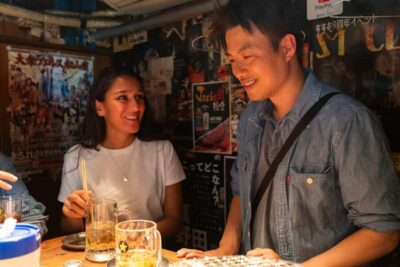

Hidden Osaka Foodie Tour: Nishinari Backstreets & Local Dining
Read our review →
Browse the lists this tour appears in