
Reviewed · OSAKA NIGHT TOURS
Osaka Traditional Performing Arts Heritage Night
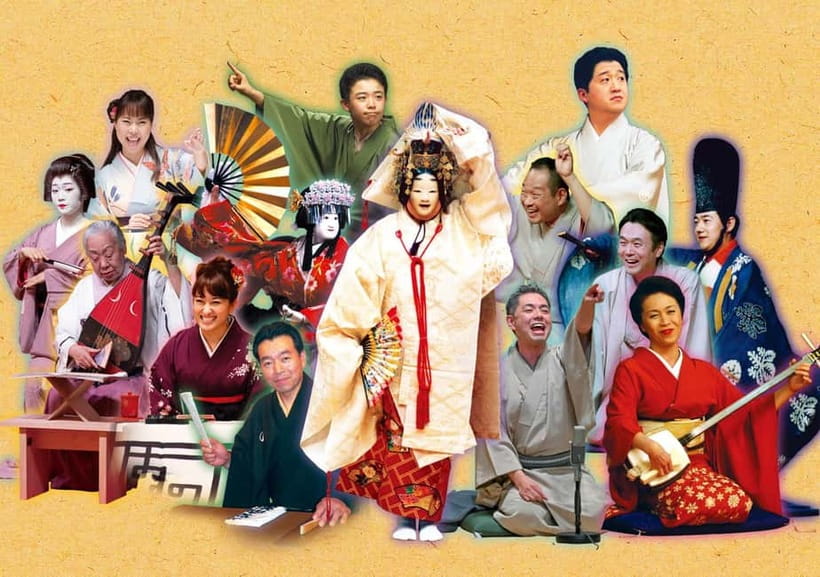
Osaka’s traditional theater can feel like a locked box if you do not know the rules. This two-hour program gives you the key by placing short examples of Noh, Kyogen, Bunraku, Rakugo, and other Osaka arts into one evening. You get explanation before each segment, then see the form in action rather than trying to decode it from a long, unfamiliar performance.
I like the clear English support, especially the subtitles and printed materials. I also like the hands-on part, where a few audience members put on white socks and step onto the Noh stage to try elements of the arts themselves. The main limitation is simple: this is a sampler, not a full evening devoted to one complete play or style. Children under seven are not permitted, and photography and video recording are not allowed inside.
Key points to know before you book
- One program covers many art forms: Expect highlights from Noh, Kyogen, Bunraku, Rakugo, Rokyoku, Kodan, Kamigata Mai, Gagaku, Onna Doraku, and Chikuzen Biwa.
- English help is built into the show: The presentation includes multilingual explanations, subtitles, and materials, with English and Japanese available.
- The audience can take part: A couple of people may wear white socks and go onto the Noh stage for a hands-on introduction.
- The format suits beginners: Each shorter performance is explained before it begins, so you do not need prior knowledge of Japanese theater.
- Plan for two focused hours: The program packs in many brief examples, which keeps the pace moving but leaves less time for any single art.
- The setting is authentic: The experience is provided by Yamamoto Noh Theater, an Osaka venue connected with the Noh stage tradition.
A two-hour introduction at Yamamoto Noh Theater
The strength of this experience is its shape. Instead of asking you to commit to a full Noh performance, a Bunraku production, or an evening of spoken storytelling, it gives you a guided tour through several forms in one sitting.
That makes it especially useful early in an Osaka visit. You can see what catches your attention, then decide if you want to seek out a longer performance later. I find this kind of first encounter far more helpful than reading a list of art forms and hoping the names begin to make sense.
The program is presented at Yamamoto Noh Theater, and the host or greeter works in English and Japanese. The exact starting time depends on availability, but the total program lasts two hours. That is long enough to give each art a proper introduction without turning the evening into a test of your concentration.
You should think of the show as an omnibus performance. You will receive selected highlights and shorter presentations rather than a single story told from beginning to end. That tradeoff is the whole point: you gain range, but not the full dramatic arc of any one production.
More night tours in Osaka:
- Osaka After Dark: Small-Group Night Food Tour (Max 6)
★ 4.5 · 245 reviews - OSAKA NIGHT FUSION Japanese Taiko Kabuki Samurai Dance Show
★ 4.8 · 155 reviews - Osaka: Bar-Hopping Night Tour in Namba
★ 4.7 · 117 reviews
Noh gives the evening its stage and atmosphere
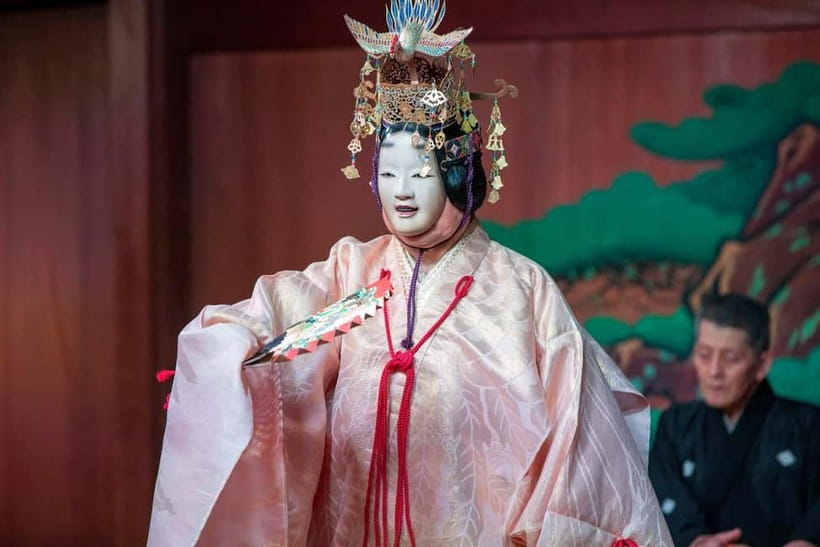
Noh is likely to be the visual anchor of the program. It is performed on a distinctive stage, and the presentation includes the chance for a couple of audience members to wear white socks and step onto it for a hands-on experience.
That detail matters because Noh is not only about masks, movement, music, and words. The stage itself is part of the art. Standing on it, even briefly, gives you a better sense of how carefully space and movement are used.
You may not take photographs or video inside, so you will need to pay attention rather than record the moment. That restriction may disappoint anyone hoping to document the performance, but it also keeps phones from becoming the main event. Bring your curiosity, not your camera plan.
The program is designed for newcomers, so you are not expected to recognize every gesture or understand the structure in advance. Explanations before the performances help you watch for the right details. You may still find Noh slow or formal compared with more modern stage entertainment, but the shorter format makes that easier to handle.
Kyogen adds humor to the formal program
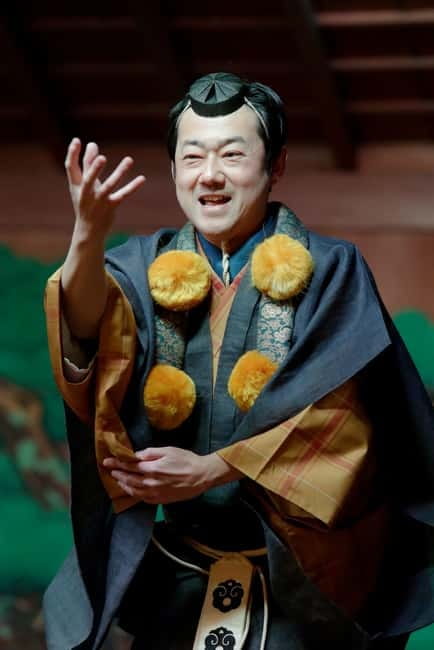
Kyogen is traditionally associated with comic performance, and its place in this program helps balance the more solemn feel of Noh. The contrast is useful. After seeing the controlled movement and serious tone of Noh, you can notice how comedy uses timing, expression, and everyday behavior in a different way.
This is one reason the experience works well for families with older children and teenagers. A teenager may not connect with every musical or ceremonial element, but humor can provide a quick way into the subject. One family brought two children aged eight and six and found that both stayed engaged, though the official rule excludes children under seven.
You should not expect every segment to land in the same way for every person. Humor can depend on translation and cultural context. The explanations and subtitles help, but they cannot reproduce every shade of a Japanese joke. Still, Kyogen gives the evening a change of pace and shows that traditional theater is not all solemn masks and measured steps.
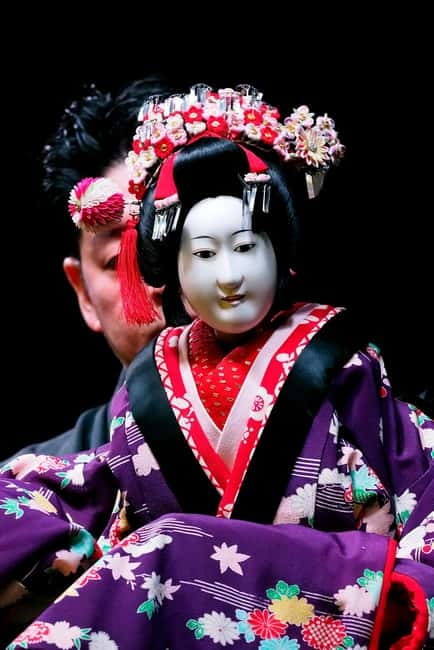
Bunraku shows Osaka’s puppet tradition
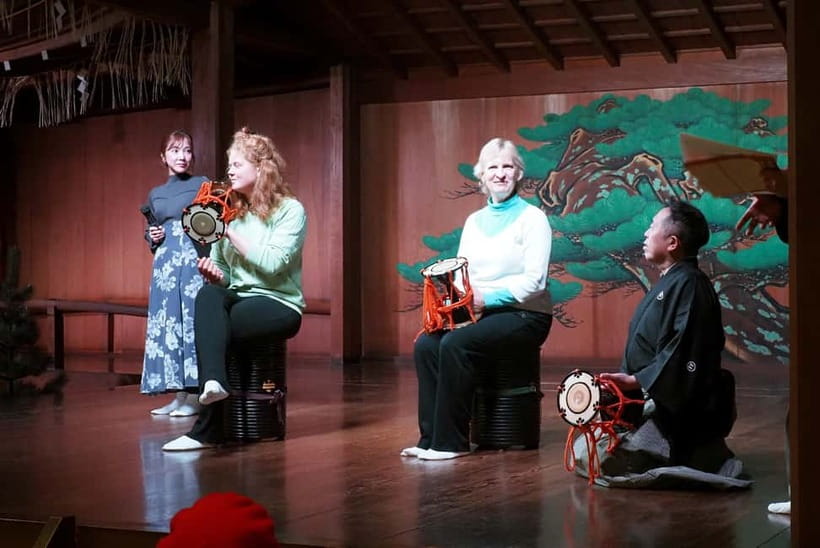
Bunraku is one of the major forms associated with Osaka, and seeing it in a mixed program gives you a useful first look at the relationship between puppetry, narration, and music.
You will not get the time required for a full Bunraku drama in this two-hour format. Instead, the presentation offers a highlight. That means you can notice the precision and coordination of the form without needing to follow a long plot with unfamiliar names.
For me, this is where the subtitles and printed materials earn their place. Traditional Japanese performance often combines spoken language, song, instrumental sound, and movement at once. If you are hearing the language for the first time, written support lets you follow the basic meaning while watching the performers.
Bunraku also gives the program a clear Osaka identity. The evening is not a generic collection of Japanese stage forms brought together at random. It specifically presents Osaka traditional performing arts, and Bunraku helps show why the city matters in that story.
More history tours in Osaka:
- Osaka: Castle History Walking Tour / Castle Tower Admission
★ 4.9 · 230 reviews - Osaka: Osaka Castle & Historical Museum Guided Tour
★ 4.8 · 28 reviews - Osaka Castle & Samurai History Walking Tour
★ 5.0 · 22 reviews - Osaka: Kyoto & Nara & Uji Historical and Scenic One-Day Tour
★ 4.7 · 21 reviews
Rakugo, Rokyoku, and Kodan use the spoken word
The program also introduces several forms built around storytelling and speech: Rakugo, Rokyoku, and Kodan. These can look deceptively simple from the outside. A performer may sit or remain in a small performance area, yet voice, rhythm, posture, and timing do a great deal of work.
Rakugo is known for a solo storyteller using limited props and changing character through voice and movement. In a short introduction, you can focus on how one performer creates a scene without a large cast or elaborate set.
Rokyoku combines narrative with music, while Kodan has its own storytelling tradition. You may not absorb every detail in a single sitting, but the program lets you compare their styles. Listen for the different pace, vocal pattern, and relationship between spoken material and music.
English subtitles and explanations are particularly valuable here. A performance based almost entirely on language is difficult to follow if you do not speak Japanese. You may still miss wordplay, but you will have enough support to understand the role of storytelling and see how much expression can come from one performer.
Music, dance, and less familiar forms widen the picture
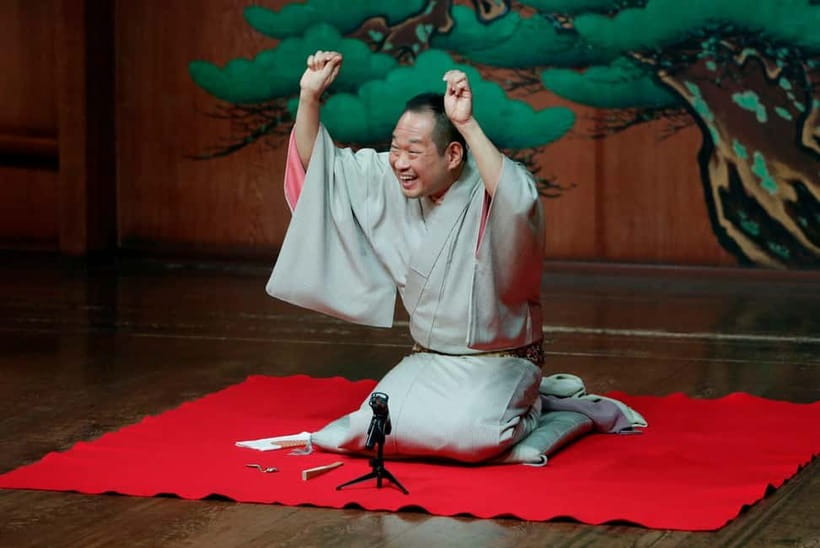
The program goes beyond the best-known names. You may also see Kamigata Mai, Gagaku, Onna Doraku, and Chikuzen Biwa.
Kamigata Mai connects the evening with dance traditions from the Osaka and Kyoto area. Gagaku introduces an older court music tradition, while Chikuzen Biwa features the biwa, a Japanese stringed instrument used in narrative performance. Onna Doraku adds another less familiar form to the program.
These sections may be brief, but they prevent you from leaving with the mistaken idea that Japanese traditional performance means only Noh, Kabuki, or puppets. The range is the useful part. You get to compare stage movement, instrumental sound, spoken story, comic acting, and dance within the same night.
The exact balance among the forms may vary with the performance version. The available information describes an English version with subtitles, and some presentations may include material performed fully in English. Check the available language option when booking if following every word is important to you.
How the explanations change the experience
A short introduction before each performance can make a large difference. Without context, you might notice a mask, a drum, or a stylized gesture but have no idea why it matters. With a little explanation, you can watch for the structure and purpose of what follows.
The support is aimed at foreign audiences as well as Japanese speakers. English and Japanese are available, with multilingual explanations, subtitles, and materials. This does not turn every traditional form into a modern English-language show, but it gives you a workable path through the evening.
I would treat the subtitles as a guide, not a substitute for watching the stage. Keep your attention on the performers and use the text to catch the plot or key terms. The best moments are often visual or musical, and you do not need to understand every sentence to appreciate a change in rhythm or gesture.
The explanations also make this a good option for a mixed group. One person can arrive with an interest in theater, another with an interest in Japanese culture, and a teenager can still find humor or novelty in the presentation. Nobody needs to prepare by studying Noh terminology beforehand.
The hands-on segment is more than a photo opportunity
The audience participation is limited, which is a good thing. A couple of people wear white socks and go onto the Noh stage to experience selected elements of Osaka’s traditional performing arts.
You should not book this expecting a workshop where everyone performs. Most of the audience watches, and only a few people take part. But even as a spectator, you gain something from seeing how the stage is used and how unfamiliar movements feel when a person tries them for the first time.
If you are selected, follow the instructions carefully and treat the stage with respect. The white socks are part of the activity, and the no-photography rule means the experience is for the people in the room rather than for social media.
This hands-on piece is especially helpful for younger visitors over the minimum age. It turns an abstract subject into something physical and memorable. Even if you remain seated, you can see that traditional performance involves discipline and control, not just costumes and old stories.
Who will get the most from the $32 price
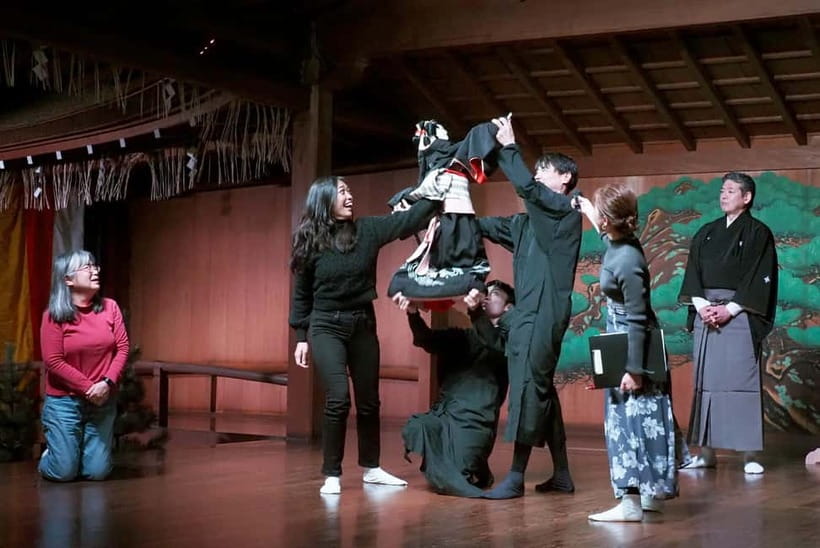
At $32 per person, the value depends on how you use the evening. If you want one complete, high-production performance in a single tradition, this may not be the right choice. You are paying for access to a broad introduction, explanations in English, a respected theater setting, and the chance to try selected activities.
For a first look at several art forms, the price is reasonable. A two-hour program gives you enough material to understand the differences between Noh, Kyogen, Bunraku, spoken storytelling, dance, and music. You are also less likely to spend money on a longer performance that turns out not to suit your taste.
I would especially consider it if your Osaka schedule has room for one evening cultural activity but not several separate theater visits. It can also be a good choice for a couple or family with different interests because the program keeps changing form.
The value drops if you dislike sampler-style events. You will not receive a complete Bunraku play, a full-length Noh drama, or an extended Rakugo set. If you already know exactly which art you want, a dedicated performance may give you more depth for your time.
Practical details that affect your evening
The activity lasts two hours, and starting times depend on availability. Check the schedule before building dinner or another attraction around it. The program is held indoors at Yamamoto Noh Theater, and wheelchair access is available.
English and Japanese support is provided by the host or greeter. The published experience also allows cancellation up to 24 hours before the start for a full refund, and you can reserve now and pay later. Those terms are useful if your Osaka plans are still shifting.
Children under seven cannot attend. Older children may enjoy the mixture of humor, history, music, and audience participation, but attention span still matters. A six-year-old may manage the content in some circumstances, but the stated age rule is the one to follow.
Leave your camera and video plans behind. Photography and video recording are not allowed inside. If you want a souvenir, rely on the printed materials and your memory.
Is this Osaka performing arts night right for you?
Book this experience if you want a clear first introduction to Osaka’s traditional stage arts, especially if you need English explanations. It is also a smart pick if your group includes people with different interests or if you want to sample several forms before choosing a longer performance.
Skip it if you want one complete drama, extensive audience participation, or unrestricted photography. The program moves across many forms, so depth is limited by design.
My practical recommendation is to choose it early in your Osaka stay. You will leave with a better sense of what you are seeing elsewhere in Japan, and the mix of humor, history, music, and hands-on activity gives you plenty to discuss afterward. At $32, it is a sensible cultural introduction, provided you understand that the evening is a guided sampler rather than a full theater production.
FAQ
How long does the Osaka Traditional Performing Arts Heritage Night last?
The experience lasts two hours.
Which traditional performing arts are included?
The program may include Noh, Kyogen, Bunraku, Rakugo, Rokyoku, Kodan, Kamigata Mai, Gagaku, Onna Doraku, and Chikuzen Biwa.
Is the experience available in English?
Yes. The host or greeter speaks English and Japanese, and the program includes multilingual explanations, subtitles, and materials. English versions may include performances or sections presented fully in English.
Can the audience participate?
Yes. A couple of audience members wear white socks and go onto the Noh stage to try selected elements of traditional performing arts.
Are children allowed to attend?
Children under seven are not allowed to attend. Older children may attend, subject to the activity’s rules.
Can I take photos or record video inside?
No. Photography and video recording are not allowed inside the theater.
Is the theater wheelchair accessible?
Yes, the activity is wheelchair accessible.
Just added in Osaka
- Urban Canvas: Osaka Street Art Bike Tour★ 5.0 · 10 reviews
- Anime Cosplay Photshoot-50 Digital Photos Provided★ 5.0 · 8 reviews
- TeamLab Botanical Garden Osaka Ticket★ 3.5 · 6 reviews
- Umeda Sky Building & Kuchu Teien Observatory Ticket in Osaka★ 4.5 · 3 reviews
- Immerse in Judo Martial Arts Class from Japan★ 5.0 · 4 reviews
- Cherry Blossom Buddha and Mt.Yoshino with Strawberry Picking Tour★ 4.5 · 5 reviews
- Traditional Home cooking Experience in Osaka, Japan★ 5.0 · 14 reviews
- Traditional Calligraphy Experience near Dotonbori★ 5.0 · 3 reviews
Osaka Night Tours, compared.
Osaka After Dark: Small-Group Night Food Tour (Max 6)
Read our review →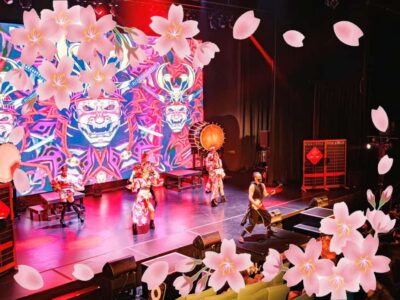
OSAKA NIGHT FUSION Japanese Taiko Kabuki Samurai Dance Show
Read our review →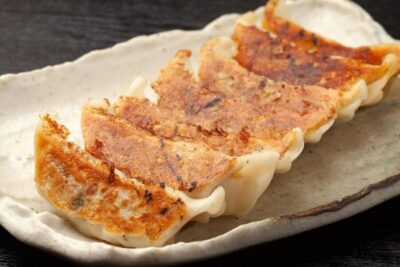

Hidden Gems and Bustling Districts of Osaka Night Tour
Read our review →
Night Soul Food Tour in Shinsekai with a local guide
Read our review →
3.5h Osaka Night guided Local Bar Hopping, Sake & Karaoke
Read our review →Browse the lists this tour appears in