
Reviewed · OSAKA WALKING TOURS
Osaka: Castle History Walking Tour / Castle Tower Admission
Osaka Castle is more than a photogenic tower. Its real story is built into the triple moats, angled walls, and maze-like gates designed to slow an army under fire. This tour makes you notice the traps before taking you up for wide views over Osaka.
I like the way the guide explains the castle as a working military machine, not just a museum. I also like the practical separate entrance, which can save time at a busy site. The main drawback is that the tour covers the castle grounds and key points rather than providing a guided explanation of every museum floor inside the tower.
Key points to know before you go
- The castle’s defenses are the main event: You’ll follow moats, gates, zigzag routes, and masugata entrances built to confuse and divide attackers.
- The largest stone gives the tour a memorable focus: You’ll hear how builders moved huge blocks in the 16th century and spot marks left by stone craftsmen.
- The English-speaking guides add real context: Guides including Mao, Spike, Kaz, Yuta, Saya, Ken, and Yu are praised for clear explanations and friendly pacing.
- The separate entrance can matter at busy times: An early start, especially around 9 a.m., may help you avoid longer lines later in the morning.
- The tower view is a fitting finish: You reach the top for Osaka views, then have time to explore the castle museum on your own.
- The visit includes Hokoku Shrine: This adds a quieter cultural stop and ties the castle to Toyotomi Hideyoshi’s legacy.
Why Osaka Castle makes more sense when you see it as a fortress
A first look at Osaka Castle can be misleading. The bright tower, rebuilt in concrete and filled with museum displays, has the visual punch. Yet the most interesting part is outside, where the castle’s defenses still shape your route.
Your guide points out how attackers would have faced layer after layer of protection. The outer moats created distance. The high stone walls made climbing difficult. Gates forced soldiers into narrow spaces, and the route repeatedly turned instead of running straight toward the center.
This is the castle’s military logic in plain view. An army could not simply march through a main gate and reach the tower. It had to cross open ground, pass barriers, make sharp turns, and squeeze through controlled entrances while defenders fired from above.
I especially like the explanation of masugata entrances. These boxed-in gate areas forced attackers into a confined space between gates. Once inside, they could be held, separated, and attacked from several directions. The design was not decorative. It was a carefully planned delay system.
You’ll also walk routes that zigzag instead of offering a direct approach. Those turns helped defenders control movement and made it harder for an invading force to keep its formation. Seeing this on foot is far more useful than reading the words defensive architecture on a sign.
More walking tours in Osaka:
- Osaka Local Foodie Walking Tour in Dotonbori and Shinsekai
★ 5.0 · 985 reviews - Osaka: Deep Backstreets Walking Tour with Dinner Option
★ 4.9 · 902 reviews - Ultimate Osaka Walking Tour: Castle, Dotonbori & Hidden Gems
★ 5.0 · 862 reviews
Meeting at Lawson S Otemae Rest House Store

The tour begins in front of Lawson S Otemae Rest House Store. This detail matters because there are several Lawson stores in the area, so you should check the exact Google Maps location before setting out.
Look for the Local Guide Stars sign. Arriving at the right store is especially important in the busy castle area, where a small navigation mistake can cost you the start of a short tour.
Wear comfortable shoes. The route moves through historical grounds, across paths, and toward the tower, so this is not the right outing for stiff footwear. Weather-appropriate clothing also matters because much of the explanation takes place outdoors.
The tour is advertised as 90 minutes, with a live English-speaking guide. The exact pace can vary with crowd levels, questions, and the movement into the tower. Guides such as Kaz and Yu have been praised for adjusting the pace, answering questions, and making room for photographs. That flexibility is helpful for families and groups with different walking speeds.
Moats, gates, and the castle’s built-in traps
The early part of the walk focuses on the castle grounds and its defensive layers. Your guide explains the role of the triple moats and the way each section added another obstacle for an attacking force.
The moats are not just scenic water features. They helped create space between the castle and its enemies. That open space gave defenders time to see an approaching army and attack it before it reached the walls.
At the gates, look for the way the route narrows and changes direction. The castle’s builders used entrances that made an attacker slow down and lose a clear view of the next target. A large force becomes less useful when it is split into smaller groups.
The guide also points out wall angles and the arrangement of the stones. The walls were built to make climbing difficult, with sloping surfaces that gave soldiers little easy purchase. This is one of the places where a guide earns the fee. On your own, you may admire the stones without understanding why the slope mattered.
Several guides have been singled out for finding good photo locations while still explaining the site. That balance suits Osaka Castle. You will want pictures, but a stop to frame the tower or the walls is better when you also know what you are looking at.
The giant stone and the marks left by craftsmen
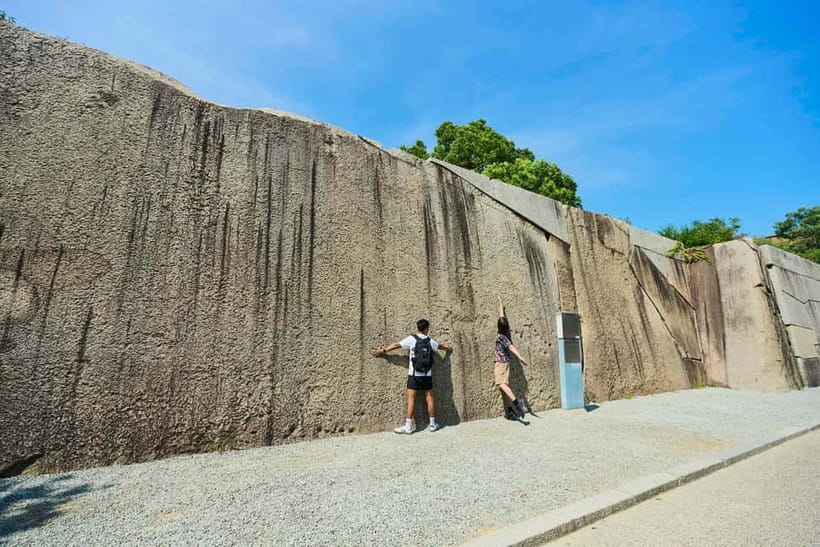
One of the tour’s strongest details is the castle’s largest stone. It gives the history a physical scale that dates and names alone cannot provide.
You’ll hear how stones of this size were transported in the 16th century. The subject turns construction into a human problem: how to move enormous blocks without modern machinery. The explanation helps you picture the labor, planning, and organization needed to build a fortress of this size.
The walls also preserve marks associated with the master craftsmen and groups who worked on them. These marks are easy to miss. They are not grand monuments, but they offer clues about the people who built the castle and the way large construction projects were organized.
This is a good example of the tour’s value. You are not only being shown the famous tower. You are being directed toward small details that can disappear in a self-guided visit.
The stone walls are also a useful reminder that the castle’s power came from the whole site. The tower gets the attention, but the moats, gates, walls, and routes did much of the defensive work.
More history tours in Osaka:
- Osaka: Osaka Castle & Historical Museum Guided Tour
★ 4.8 · 28 reviews - Osaka Castle & Samurai History Walking Tour
★ 5.0 · 22 reviews - Osaka: Kyoto & Nara & Uji Historical and Scenic One-Day Tour
★ 4.7 · 21 reviews - (Ticket Included) Explore Osaka Castle & Museum of History
★ 4.8 · 21 reviews
Hokoku Shrine and the Toyotomi connection
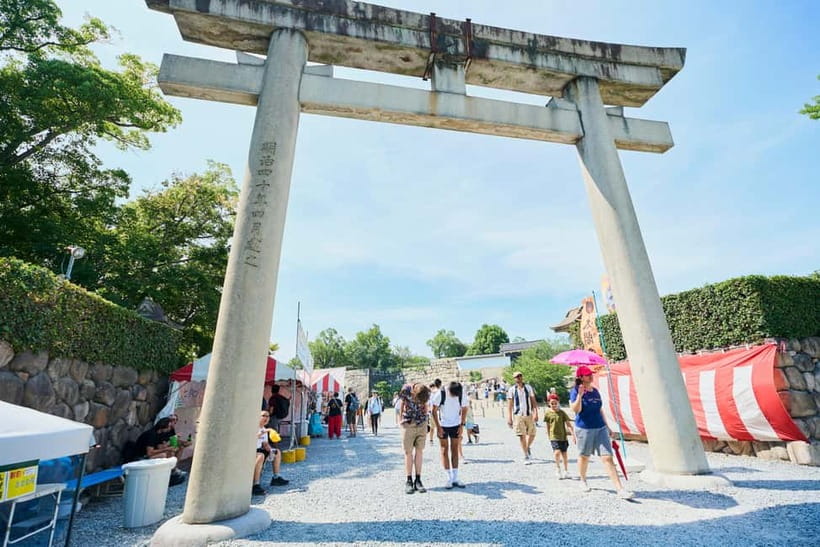
The itinerary includes a guided stop at Hokoku Shrine. This adds a cultural and political layer to the castle visit, especially because the tour connects the site with Toyotomi Hideyoshi’s legacy.
The shrine stop gives you a change of pace after the military architecture. Instead of looking only at walls and entrances, you consider the people and ambitions tied to the castle.
A traditional Japanese wedding ceremony may sometimes be taking place at the shrine, though that is not something you can count on. The stop is best treated as part of the historical route, with the possibility of seeing ordinary religious and cultural activity along the way.
The guide uses this section to explain the rivalry between the Toyotomi family and Tokugawa Ieyasu. That rivalry is central to understanding why Osaka Castle mattered so much. The castle was not simply a stronghold. It represented power, inheritance, and a challenge to the Tokugawa order.
Why the castle fell despite its defenses
The story becomes more interesting because the castle was not truly invincible. Your guide explains how it fell during the conflicts of 1614 and 1615, when Tokugawa Ieyasu moved against the Toyotomi side.
This is where the tour moves beyond engineering. A fortress can delay an army, control its movement, and make an assault costly. It cannot settle political conflict by itself.
The castle’s fall gives the defenses a sharper meaning. The moats and walls worked as planned, but strategy, alliances, leadership, and changing conditions mattered too. The result was not a simple tale of strong walls defeating weak attackers.
I like this part because it prevents the visit from becoming a list of architectural features. You learn why the castle was built, what it symbolized, and why its military design still could not preserve Toyotomi power.
Entering the tower and looking across Osaka
Castle tower admission is included, and the tour uses the tower as both a command post and a final defensive position. Your guide points out arrow slits and gun ports, features that show how the building was intended to function in wartime.
Gold also enters the story. The castle’s glitter was not only for decoration. Gold could project wealth and authority, while also affecting how an enemy judged the power of the people inside. It was psychological warfare as much as display.
The climb or movement through the tower leads to the city view at the top. This is the natural payoff after walking through the defensive layout. From above, you can better understand the castle’s position and the amount of land its rulers controlled.
Keep in mind that the guide does not provide a guided tour of each museum floor. The group is guided through the main historical points and into the tower, but the museum exhibits are for you to explore independently.
That arrangement works well if you want a clear introduction without being held to a long museum lecture. It is less suitable if your main goal is a floor-by-floor explanation of every exhibit.
The tower can become busy, especially later in the morning. One visitor specifically found the 9 a.m. start useful because lines had grown by around 11 a.m. An early time can also leave you with more of the day for nearby food stalls and other Osaka sights.
The guides make the difference
The experience is sold with a professional English-speaking guide, and the guide is central to its value. Names appearing across the recent tour teams include Mao, Spike, Kaz, Yuta, Saya, Ken, Yu, Ami, Kat, Kenta, Kimie, Sayaka, and Ukyo.
You should not expect one particular guide unless the booking system identifies that person for your date. Still, the repeated strengths are clear: warm communication, strong explanations, help with photographs, and a willingness to answer questions.
Spike is praised for connecting the castle with the Tokugawa period and for keeping the walk comfortable for an older group member. Mao is praised for pointing out details that are easy to miss and for making the history accessible. Yuta is noted for answering detailed questions and keeping the conversation friendly.
Kaz has been praised for adapting the route to a delayed arrival and a family member with mobility concerns. That does not make the tour a formal accessibility service, but it suggests that you should tell the guide about your needs at the start.
Some departures may be very small. A solo participant once received what was effectively a private walk when no one else joined. You should not book expecting a private tour, but a small group can make it easier to ask questions and set the pace.
Families can also fit this experience well. A guide has kept even a three-year-old engaged, and teenage children have enjoyed the combination of stories, walls, and photo stops. The military strategy gives the visit a simple thread that younger visitors can follow.
Is $33 a fair price?
At $33 per person, the price includes the Osaka Castle Tower admission and the English-speaking guide. The value depends on how you like to visit major historic sites.
If you are happy to read signs and wander without context, you can spend less by visiting independently, though the admission ticket would still be a separate consideration. If you want someone to explain why the gates turn, what the stone marks mean, and how the castle fell, the added cost is easier to justify.
The separate entrance is another part of the value. It does not remove every possible wait, and crowd levels can change, but it can help you avoid the main ticket line and reach the tower more smoothly.
I would see this as a good use of money for a first visit to Osaka Castle, especially if history, architecture, or military strategy interests you. It is less compelling for someone who mainly wants a quick photograph of the tower and does not want a guided walk.
The short format also helps. You get a focused explanation rather than spending half a day on every corner of the site. Afterward, you can continue exploring the castle museum or grounds at your own speed.
Who should book this castle walk?
I would recommend it most strongly if you want to understand what you are seeing. The castle grounds are large, and the key defensive features are easy to pass without a guide.
It suits:
- First-time visitors to Osaka Castle
- People interested in Japanese political and military history
- Architecture fans who want to understand walls, gates, and moats
- Families who benefit from a clear story and regular stops
- Solo visitors who want an informed introduction
- Anyone concerned about wasting time in the main ticket line
You may prefer an independent visit if you want to spend hours inside the museum, move at your own pace, or focus mainly on photography. Remember that the guide does not lead you through every floor of the museum.
Cancellation is free up to 24 hours before the activity, and you can reserve now and pay later. Those policies are useful if your Osaka schedule is still shifting, but the more important decision is whether you want a guided explanation of the grounds.
My verdict: book it for the defenses, not just the tower
Book this tour if you want Osaka Castle to make sense. The tower view is worthwhile, but the best material comes earlier: the moats, masugata entrances, zigzag paths, giant stone, wall angles, and the story of a fortress built to control an army.
Choose an early departure if your schedule allows, especially around 9 a.m., when the site may be easier to manage. Bring good shoes, check the exact Lawson meeting point, and expect to explore the museum floors on your own after the guided portion.
At $33, this is a sensible choice for a history-minded visitor who values clear English explanations and saved time. It is not a complete museum tour, but it gives you the tools to see why Osaka Castle was built, how it worked, and why even an impressive fortress could fall.
FAQ
How long is the Osaka Castle walking tour?
The activity is advertised as 90 minutes. The walking portion covers the castle grounds, defensive features, Hokoku Shrine, and the castle tower.
What is included in the price?
The price includes Osaka Castle Tower admission and a professional English-speaking guide.
Is the tour conducted in English?
Yes. The activity includes a live English-speaking guide.
Does the guide explain every floor inside Osaka Castle?
No. Guided explanations focus on the castle grounds, history, architecture, and main points inside the tower. Guided tours of each museum floor are not included.
Where does the tour meet?
Meet in front of Lawson S Otemae Rest House Store. There are several Lawson stores nearby, so check the correct Google Maps location and look for the Local Guide Stars sign.
What should I bring?
Bring comfortable shoes and clothing suited to the weather. The activity involves walking through historical sites and includes outdoor sections.
Just added in Osaka
- Urban Canvas: Osaka Street Art Bike Tour★ 5.0 · 10 reviews
- Anime Cosplay Photshoot-50 Digital Photos Provided★ 5.0 · 8 reviews
- TeamLab Botanical Garden Osaka Ticket★ 3.5 · 6 reviews
- Umeda Sky Building & Kuchu Teien Observatory Ticket in Osaka★ 4.5 · 3 reviews
- Immerse in Judo Martial Arts Class from Japan★ 5.0 · 4 reviews
- Cherry Blossom Buddha and Mt.Yoshino with Strawberry Picking Tour★ 4.5 · 5 reviews
- Traditional Home cooking Experience in Osaka, Japan★ 5.0 · 14 reviews
- Traditional Calligraphy Experience near Dotonbori★ 5.0 · 3 reviews
Osaka Walking Tours, compared.
Osaka Local Foodie Walking Tour in Dotonbori and Shinsekai
Read our review →
Deep Backstreets Walking Tour with Dinner Option
Read our review →
Ultimate Osaka Walking Tour: Castle, Dotonbori & Hidden Gems
Read our review →
Main Sights and Hidden Spots Guided Walking Tour
Read our review →
Private Osaka Walking Tour: Highlights & Hidden Gems
Read our review →
Osaka Castle Walking Tour and Castle Tower Admission
Read our review →
Kuromon Market Food Walking Tour in Osaka (6 stops, 6 tastes)
Read our review →
Five Must-See Highlights Walking Tour & Ramen Lunch
Read our review →Browse the lists this tour appears in