
Reviewed · OSAKA
Sharpen Japanese Knives in Osaka
Sakai has made knives for about 450 years, yet the most interesting part is not simply buying one. You get to see how several skilled workers contribute to a blade, then sit down with whetstones and learn the patient work of sharpening it yourself. The handle fitting adds another hands-on lesson.
I like the museum visit because it gives the workshop a proper setting, and I like the small maximum of five people, which should leave room for questions. Guide Yuji has been praised for his clear English and punctual welcome. The main drawback is price: at $213 for about two hours, this is a specialist experience, not a cheap sightseeing stop.
Key points
- Sakai’s 450-year knife tradition: Learn why this Osaka-area city is known for blades and metalwork.
- A real sharpening lesson: Use whetstones and receive instruction on proper technique.
- Make part of your own knife: Fit the handle into the blade using a traditional method.
- Small group size: The activity accepts a maximum of five people.
- Practical inclusions: Your booking covers an apron, sharpening tools, a knife, and coffee or tea.
- English-speaking guidance: Yuji has been praised for explaining both the museum displays and workshop clearly.
Why Sakai is the right place to learn knife craft
Many visitors come to Osaka for food, castles, and neon streets. Sakai offers a quieter look at the work behind Japanese cooking. The city has been known for knives for roughly 450 years, and the craft still depends on people with narrow, specific skills.
That division of labor is one of the most useful things to learn here. One person may work on a blade, another may sharpen it, and another may fit the handle. A finished knife can look simple, but it represents several stages and several pairs of trained hands.
This activity lets you see that process from two angles. At the Sakai Traditional Industrial Hall, you get the broad picture: different types of knives, their uses, and the way they are made by hand. At Wada Store, you move from watching to doing.
That change matters. A museum display can explain a craft, but a whetstone makes you notice the pressure, angle, patience, and control involved. You will not just hear that sharpening takes skill. You will feel how easy it is to get the movement wrong.
Other Osaka bookings people put this one up against:
- Osaka Go Karting Tour with Funny Costume
★ 5.0 · 2,658 reviews - Osaka Castle: Museum and Tower Entry Ticket
★ 4.5 · 2,380 reviews - Osaka: Shinsekai Food Tour with 13-15 Dishes at 5 Eateries
★ 4.8 · 2,204 reviews
Starting at Wada Store in Sakai
The listed meeting point is Wada Store at 1-chōme-1-1 Shinmeichōhigashi, Sakai Ward, Sakai, Osaka 590-0935. The activity ends back at the meeting point, so you do not need to arrange a separate finish point or wonder where the workshop leaves you.
The experience is near public transportation, which helps when you are making the trip from Osaka. One account describes Yuji meeting the group at Sakai station and walking about half a mile to the knife museum before continuing to a small shop. Since the official starting point is Wada Store, check your booking confirmation for the exact meeting arrangement.
This is a useful detail to settle before you leave Osaka. Sakai and Osaka are close enough to combine, but they are not the same stop on your map. Give yourself enough time to reach the correct address, especially if you are carrying luggage or planning another timed activity afterward.
The activity is listed at about two hours. That is short enough to fit into a half-day plan, but the museum visit and walk described above may make the outing feel longer from start to finish. I would avoid booking a tight lunch reservation or train connection immediately afterward.
The Sakai Traditional Industrial Hall in 30 minutes
The first formal stop lasts about 30 minutes at the Sakai Traditional Industrial Hall. Admission is included at no extra cost, and the visit explains the range of knives made for different purposes along with the handwork behind them.
This stop gives you essential vocabulary and context before the practical lesson. You will see that a knife is not just a general kitchen tool. Different purposes call for different forms, and the displays help show why Sakai has such a strong place in Japanese metalwork.
Thirty minutes is not a long museum visit. That is good news if you prefer a focused stop rather than a full morning indoors. The tradeoff is that you should not expect a broad museum tour covering every part of Japanese industrial history. The value lies in preparing you for the workshop.
Yuji has been praised for explaining the displays in English. That can make a real difference here, since the interest is in the work process, not only in looking at finished knives behind glass. A guide who can connect the objects to the people and steps involved makes the short visit more useful.
The museum also helps you understand why the workshop is in Sakai rather than in central Osaka. You are not being shown a generic tourist demonstration. You are visiting a city where knife production has been part of local life for centuries.
Learning to sharpen with whetstones
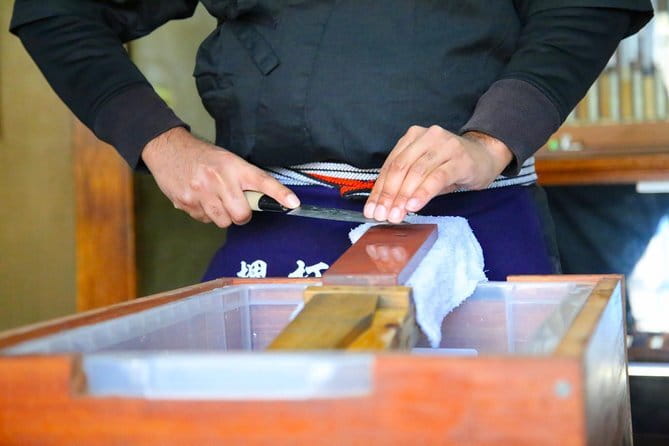
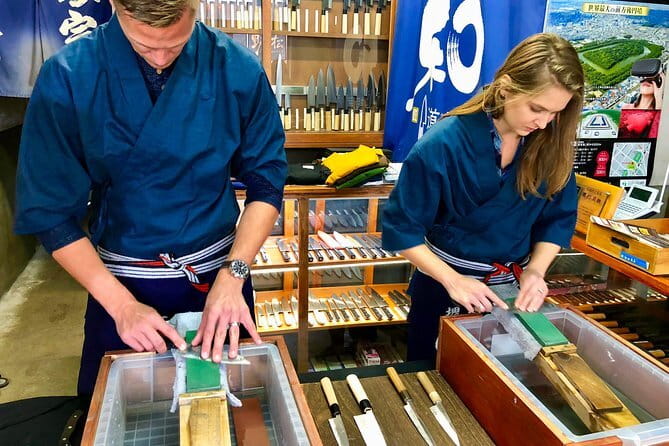
The main part of the experience takes place at Wada Store and lasts about 90 minutes. Here, a sharpener teaches you how to use whetstones properly.
Sharpening is often treated as a minor household chore. In this setting, it becomes the central craft. You learn that making a blade sharp is not simply a matter of rubbing it quickly against a stone. The work calls for a steady motion and careful handling.
The exact teaching pace will depend on your group, but the maximum of five people is a strong advantage. A class of this size should give you a better chance to watch the demonstration, ask questions, and receive correction while you work.
You do not need to arrive with your own equipment. The booking includes the tools for sharpening, an apron, and your knife. That makes the lesson easier for a visitor who wants to try the craft without packing special gear or buying supplies in advance.
The activity also includes coffee or tea. This is a small touch, but it fits the slower rhythm of the workshop. You are learning a task that rewards patience, not rushing from one display to the next.
A practical point: this is hands-on work with tools and a blade. Most people can participate, according to the activity information, but you should expect to pay attention to the instructor and follow the technique carefully. The focus is on learning proper sharpening, not simply watching someone else do it for you.
Same city, a completely different kind of afternoon:
- Osaka Food Tour: 13 Dishes at 5 Local Eateries
★ 5.0 · 2,149 reviews - Hungry Osaka Street Food Tour:15 Tastings & 3 Drinks with a Local
★ 5.0 · 1,727 reviews - Osaka: Tea Ceremony Experience
★ 4.9 · 1,426 reviews - Osaka Kickstart: Hotspots & Hidden Gems Tour
★ 5.0 · 1,306 reviews
Fitting the handle by hand

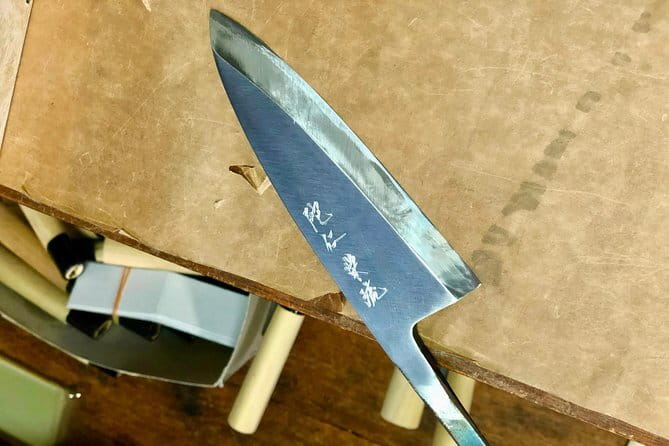
The lesson also covers how to fit a handle into a blade using a traditional method. This is a welcome addition because it shows that knife-making does not stop when the metal has been shaped and sharpened.
For many people, this may be the most memorable moment. You are not only improving an edge. You are helping complete the knife itself, with guidance from people whose family has worked with knives and sharpening for generations.
That family connection gives the workshop a personal layer, but the value does not depend on a dramatic performance. The useful part is seeing how a professional craft is passed along and how small physical adjustments affect the finished tool.
The supplied information does not specify the knife model, blade style, or handle material. You should not book this expecting a particular Japanese knife type unless the operator confirms it beforehand. What you can count on is an included knife and a lesson in sharpening and traditional handle fitting.
What the $213 price really buys you

At $213, this is expensive compared with a standard museum visit or a short cooking demonstration. You are paying for a small-group craft lesson, professional instruction, a knife, sharpening equipment, an apron, admission to the industrial hall, and tea or coffee.
The included knife matters when judging the price. You are not paying only to watch a specialist work. You receive an object connected to the lesson and spend most of the activity learning with your hands.
The group limit also changes the value. With no more than five people, the instructor has fewer learners to manage than in a large class. That is especially important for sharpening, where small changes in position and pressure may need individual attention.
I would think of this as a specialist experience for people who already have an interest in knives, Japanese cooking, traditional crafts, or practical skills. If you simply want a quick souvenir from Osaka, the price may feel high. If you want a guided lesson tied to a historic craft center, the cost is easier to defend.
There is no lunch, dinner, or snack included. Coffee and tea are provided, but plan your meals separately. Since the activity lasts about two hours, you can place it between meals, but do not treat the included drink as a full refreshment stop.
The strongest part is the human instruction
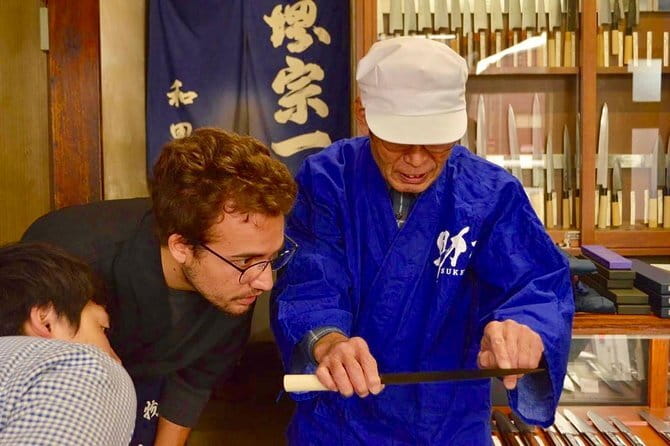
The most important factor here is the instructor. Yuji has received particularly strong praise for punctuality and English communication. Clear language matters when someone is teaching a physical technique, since a vague explanation of angle or pressure can leave you confused.
The instruction also appears to connect the museum and workshop rather than treating them as unrelated stops. First you learn what Sakai knives are and how different blades serve different purposes. Then you see how sharpening and handle fitting contribute to the finished product.
That sequence gives the outing a natural shape. You begin with local context, move to a working shop, and finish by handling the tools yourself.
The family background in knife sharpening adds credibility, but I would focus less on a grand claim of mastery and more on the chance to learn directly from a working tradition. The experience is valuable because it lets you ask questions while the craft is happening in front of you.
Who will enjoy this Sakai experience most

I would recommend this to you if you enjoy activities where the result comes from your own hands. It suits home cooks, knife collectors, food lovers, craft fans, and anyone who wants a different side of Osaka.
It also works well for a small family or group of friends. One account describes learning to sharpen a knife and fit its handle, and another describes joining friends at the workshop. The small capacity makes it easier to share the lesson without losing the instructor in a crowd.
This may not be the best fit if you want a relaxed sightseeing tour with little participation. You will need to concentrate and follow directions during the sharpening lesson. The short museum stop may also disappoint you if you want a large museum with hours of exhibits.
The activity is suitable for most people, according to the supplied information. Still, you should be comfortable handling a knife and paying attention during the practical work. No special skill level is listed as necessary.
Weather, timing, and booking cautions
The experience requires good weather. If poor weather causes cancellation, you are offered a different date or a full refund. That is helpful protection against a weather-related change, but the standard cancellation policy is strict: the booking is non-refundable and cannot be changed for any reason if you cancel or request an amendment.
Confirmation arrives at the time of booking. Keep the confirmation handy, especially because the listed meeting point is Wada Store while an account of the experience describes a station meeting. Use the confirmed instructions rather than relying only on a map pin.
The activity has a mobile ticket, so you can carry the admission details on your phone. Bring a little time before the start, and avoid scheduling something immediately afterward. A short workshop can still involve walking, orientation, and a careful finish.
Should you book this knife-sharpening lesson?
Book it if you want an intimate, practical look at Sakai’s knife tradition and you are willing to pay for instruction rather than just admission. The best reasons are the small group, the English-speaking guidance from Yuji, the included knife and tools, and the chance to sharpen and fit a handle yourself.
Skip it if your budget is tight, you are looking for a broad Osaka sightseeing tour, or you have no interest in hands-on craft. At $213 for about two hours, this is not an impulse purchase.
For the right person, though, the experience offers something a standard shopping stop cannot. You leave with a better sense of how Sakai knives are made, how much skill sharpening requires, and why a finished blade represents more than one worker’s task.
FAQ
Where does the activity start?
The listed meeting point is Wada Store at 1-chōme-1-1 Shinmeichōhigashi, Sakai Ward, Sakai, Osaka 590-0935, Japan.
Where does the activity end?
The activity ends back at the meeting point.
How long does the experience last?
The experience lasts approximately two hours. The museum portion is about 30 minutes, and the sharpening and handle lesson is about 90 minutes.
What is the price?
The listed price is $213.
What is included?
The booking includes an apron, tools for sharpening knives, your knife, coffee or tea, and admission to the Sakai Traditional Industrial Hall.
Is admission to the industrial hall included?
Yes. Admission to the Sakai Traditional Industrial Hall is included.
Is lunch included?
No. Lunch, dinner, and snacks are not included. Coffee or tea is included.
How many people can join?
The activity has a maximum of five participants.
Who leads the experience?
Yuji is identified as the guide in the supplied information. He provides English-language explanations and leads the museum and workshop portions.
What happens if bad weather cancels the activity?
If poor weather causes cancellation, you are offered a different date or a full refund.
Just added in Osaka
- Urban Canvas: Osaka Street Art Bike Tour★ 5.0 · 10 reviews
- Anime Cosplay Photshoot-50 Digital Photos Provided★ 5.0 · 8 reviews
- TeamLab Botanical Garden Osaka Ticket★ 3.5 · 6 reviews
- Umeda Sky Building & Kuchu Teien Observatory Ticket in Osaka★ 4.5 · 3 reviews
- Immerse in Judo Martial Arts Class from Japan★ 5.0 · 4 reviews
- Cherry Blossom Buddha and Mt.Yoshino with Strawberry Picking Tour★ 4.5 · 5 reviews
- Traditional Home cooking Experience in Osaka, Japan★ 5.0 · 14 reviews
- Traditional Calligraphy Experience near Dotonbori★ 5.0 · 3 reviews